




INP-WealthPk

Sindh to decarbonize 120 brick kilns under $3.5m initiative
October 15, 2026
By Abdul Ghani
The Sindh government plans to modernize more than 120 traditional brick kilns under a $3.5 million project to curb hazardous air pollution and bring the industry into the emerging carbon-credit economy, according to a document available with Wealth Pakistan.
Under the plan, more than 120 conventional brick kilns are slated for conversion to zig-zag technology by 2029, alongside training for kiln owners and workers.
The project targets an approximately 40% reduction in PM2.5 emissions – a major component of harmful fine-particle air pollution.
The document puts the proposed project budget at $3.5 million. Significantly, however, it lists both the project's completion status and financial drawdown as “not stated,” meaning the document itself does not establish that the financing has already been disbursed or that implementation has begun.
The initiative is expected to benefit around 3,000 people directly and 20,000 indirectly, while also seeking to divert 20,000 tonnes of waste annually through circular-economy interventions.
The proposed activities go beyond simply replacing or retrofitting kilns. They include cleaner-production and occupational-safety training, digital monitoring, reporting and verification (MRV), carbon-credit aggregation, and the use of fly ash and agricultural waste in compressed stabilised earth blocks (CSEBs).
A particularly significant component is the proposed establishment of a carbon MRV and crediting platform. If successfully implemented and able to meet applicable verification standards, such a mechanism could allow measurable emissions reductions from participating kilns to be aggregated and potentially linked with carbon-crediting opportunities.
According to the document, the Energy Conservation and Climate Change Department (ECC&CDD) would lead the project. GIZ and UNDP are identified as technical partners, while implementation support is envisaged from the Pakistan Brick Kiln Association and cement/fly-ash suppliers.
The Sindh Environmental Protection Agency, Labour Department, universities and research institutes are listed among the proposed collaborators.
The project envisages completion of kiln conversions by 2029, backed by baseline, mid-term and end-line reviews, third-party audits and continuous digital MRV. This monitoring architecture suggests the programme is intended to quantify environmental outcomes rather than merely count the number of kilns converted.
For Sindh, the proposal could address several problems simultaneously: inefficient kiln technology, particulate emissions, worker safety, industrial waste utilisation and the lack of verifiable emissions data needed to participate credibly in carbon markets.
The initiative nevertheless signals an attempt to shift Sindh's brick sector away from conventional, high-emission production towards zig-zag kilns, circular use of industrial and agricultural residues, digital emissions accounting and potentially carbon-linked financing.
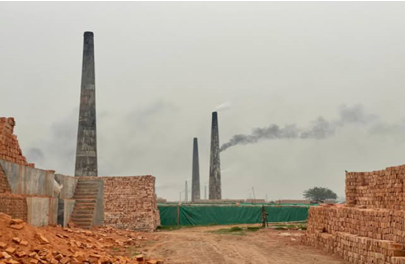
Credit: INP-WealthPk
Related Articles