




INP-WealthPk

Pakistan explores agricultural waste-to-energy technologies to cut costs, curb pollution
October 15, 2026
By Muhammad Luqman
Pakistan is increasingly exploring technologies that convert agricultural waste into energy, biochar and biofertilizers, creating opportunities for farmers to reduce energy costs, generate additional income and address crop-residue burning, a major contributor to seasonal air pollution.
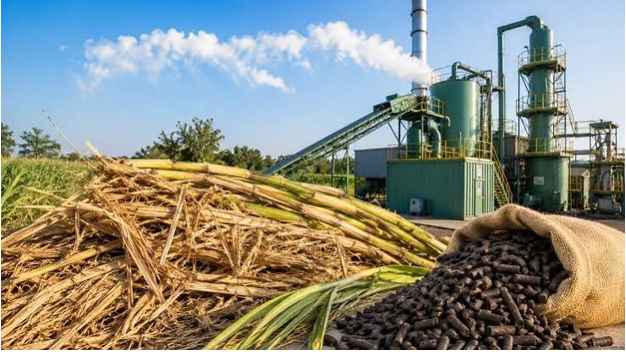
Locally manufactured biomass gasification systems are emerging as an alternative energy solution for agricultural operations, allowing crop residues such as rice husks, wheat straw and cotton stalks to be converted into combustible gas for electricity generation, machinery operation and industrial heating.
The technology could offer particular benefits to farming communities facing rising energy costs while providing an alternative use for agricultural residues that are often burned in fields after harvesting.
Muhammad Siddique Malik, chief executive of Greeco (Private) Limited, said his company was manufacturing biomass gasification machinery capable of converting agricultural waste into combustible gas for energy applications.
“We are producing biomass gasification machinery that converts biomass into synthetic gas,” he told Wealth Pakistan.
He said the gas produced through the process could be used to power tube wells, tractors and other agricultural machinery, helping farmers reduce their dependence on conventional fuels.
“We have installed 42 biomass gasification plants in Punjab that use crop residues, such as rice husks, wheat straw and cotton stalks, along with other organic materials, to produce electricity, biogas, biofuels and industrial heat,” Malik said.
He said the electricity generation capacity of locally manufactured biomass gasification plants ranged from 10 to 50 kilowatts, making them suitable for small-scale agricultural and rural energy applications.
Highlighting the potential economic benefits, Malik claimed that gas produced from agricultural waste could cost around Rs40 per kilogram, compared with approximately Rs400 per kilogram for a comparable commercial fuel such as liquefied petroleum gas (LPG).
He said electricity generated through biomass gasification could cost around Rs20–25 per kilowatt-hour, compared with approximately Rs60 per kilowatt-hour for conventional energy supplies used in agriculture.
According to Malik, biomass projects could recover their initial investment in less than 10 months through energy savings and the sale of gas, biochar and biofertilizers, depending on project operations and market conditions.
He said the company was also exploring carbon-credit opportunities in Sindh, including a proposed initiative covering 500 villages in the Mirpur Khas and Sukkur areas.
A project proposal had been submitted to the Ministry of Climate Change and Environmental Coordination, while feasibility assessments and field surveys were underway, he added.
Malik said converting agricultural residues into useful energy products could also help reduce air pollution in Punjab, where open burning of crop waste contributes to deteriorating air quality during the winter smog season.
He described biomass gasification as an emerging opportunity in Pakistan, supported by local engineering initiatives and earlier research undertaken by universities.
Biomass gasification involves heating suitable organic material at high temperatures with a controlled supply of air or another gasifying agent to produce combustible gas that can be used for energy generation.
Environmental experts believe that wider adoption of agricultural waste-to-energy technologies could help reduce open crop-residue burning, particularly in central Punjab, while supporting cleaner energy production and rural economic activity.
Hammad Naqi Khan, director general of WWF-Pakistan, said biomass conversion offered a practical option for addressing agricultural residue burning and its contribution to regional air pollution.
“It is a viable option to combat the recurring threat of regional smog and ambient air pollution caused by open stubble burning,” he told Wealth Pakistan.
However, Naqi stressed that biomass-to-energy conversion should form part of a broader agricultural residue management strategy rather than being treated as a standalone solution.
He cautioned that Pakistan's agricultural soils were already deficient in organic matter, making it important to retain and incorporate some crop residues into the soil to conserve and restore fertility.
“WWF-Pakistan, under its Rice Residue Management project, has successfully deployed field-tested machinery, including the Pak-Seeder, Zero-Tillage Drill, Paddy Straw Chopper and Kubota Combine Harvester, to manage heavy rice residue directly in the field,” Naqi said.
He said these technologies offered farmers alternatives to burning crop residues while supporting sustainable agricultural practices.
Naqi added that biomass-to-energy technologies were already being used in countries such as the United States, Brazil and India, where bagasse and other agricultural residues were utilized for bioenergy cogeneration.
The experience of these countries demonstrates the potential for agricultural residues to support energy production, although their effective use requires appropriate technology, reliable feedstock supplies and sustainable residue management practices.
Representatives of the farming community believe Pakistan could develop a stronger agricultural-residue economy by converting suitable crop waste into energy, biochar and biofertilizers, creating rural business opportunities while reducing incentives for open burning.
Ebadur Rehman Khan, director of Farmers Associates Pakistan (FAP), said government support would be essential to encourage farmers to invest in biomass conversion technologies.
“However, federal and provincial governments should incentivize farmers to establish biomass plants through loans and insurance schemes,” he told Wealth Pakistan.
Khan said successful projects within farming communities would play an important role in building confidence in biomass technologies and encouraging wider adoption of bioenergy cogeneration.
He stressed that farmers, particularly those with limited financial resources, needed access to affordable financing and protection against investment risks associated with adopting new technologies.
“The government should provide support to farmers engaged in biomass conversion and compensate them in the event of project failure,” Khan said.
Credit: INP-WealthPk
Related Articles