




INP-WealthPk

Makkah Defence Alliance takes shape as new pillar of regional security
October 15, 2026
By Abdul Wajid Khan
The Makkah Defence Alliance is taking shape as a potentially important pillar of regionally driven security architecture, with its effectiveness likely to depend on how successfully Saudi Arabia, Pakistan and Türkiye develop interoperability, joint doctrines, command arrangements and rapid-response capabilities, experts said.
The alliance is moving from political commitments towards practical implementation as its three members work to translate collective-defence arrangements into an integrated security mechanism.
According to a joint statement issued after the latest meeting of the Strategic Political and Defence Committee of the Makkah Alliance for Defence, Saudi Arabia, Pakistan and Türkiye agreed to move towards implementing their collective-defence commitments.
The committee decided to take necessary measures to provide the agreed military forces and capabilities and ensure their rapid deployment in Saudi Arabia in accordance with approved arrangements and the national legislation of the three countries.
The measures are intended to enhance military readiness and integration and strengthen the alliance’s collective capacity to confront and counter threats.
Tughral Yamin, Senior Research Fellow at the Institute of Policy Studies Islamabad, told Wealth Pakistan that the proposed deployment of rapid reaction forces in Saudi Arabia was primarily intended to provide support.
He said that although Lt Gen Nauman Mahmood had been appointed the first Secretary General, the command structure for the forces to be deployed remained unclear.
“According to reports, it appears that these troops are intended to support the defence of the Kingdom of Saudi Arabia rather than to engage in fighting the Houthis,” he said.
Yamin noted that fully operationalising a multinational military force was a long and complex process requiring the development of joint doctrines and interoperability among the armed forces of member states.
He said the alliance would also need common communication protocols, as not all member states were equally comfortable using English as the medium of communication.
Joint doctrines, interoperability, command arrangements and common communication procedures, he said, would be essential before the force could function as a genuinely integrated and rapidly deployable military entity.
“Once the joint force evolves into an integrated and interoperable entity capable of rapid deployment, it could serve as a guarantor of peace and security in the region,” he said.
The joint statement said practical measures under the alliance would strengthen deterrence and reaffirm the three countries’ resolve to defend their security, sovereignty and territorial integrity in accordance with the agreement.
The committee also condemned the attempted targeting of Makkah and Madinah, as well as continuing attacks on cities and civilian and economic facilities in Saudi Arabia, reaffirming its rejection of any threat to the Kingdom’s security and territorial integrity.
International security expert and former Senior Researcher at the Centre for Pakistan and Gulf Studies Dr Taimur Khan said operationalising the Makkah Defence Alliance could represent an important step towards developing a more regionally owned security architecture in the Gulf.
“For Saudi Arabia, an effective collective-defence mechanism could enhance deterrence through intelligence-sharing, integrated air and missile defence, maritime security, counterterrorism cooperation, cyber capabilities and coordinated responses to emerging threats,” he told Wealth Pakistan.
More importantly, Khan said, the alliance could gradually reduce excessive dependence on external security providers and strengthen the capacity of regional states to manage their own security challenges.
However, he cautioned that the success of the alliance would depend on whether it was perceived as a defensive and stabilising arrangement rather than an instrument directed against any particular regional actor.
“Collective defence should therefore be complemented by diplomatic engagement, confidence-building measures, crisis-communication channels and respect for international law,” he said.
In this context, Khan said the Makkah Defence Alliance could reshape Gulf security by combining credible deterrence with preventive diplomacy.
“If properly institutionalised, it could contribute not only to Saudi Arabia’s security but also to a more balanced, predictable and sustainable regional peace,” he said.
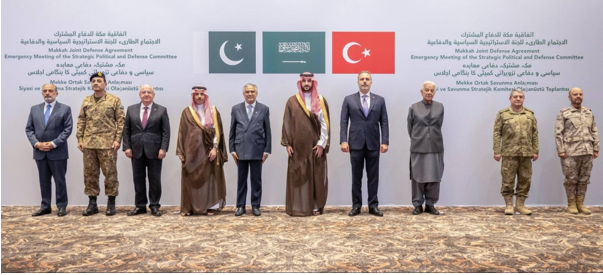
Credit: INP-WealthPk
Related Articles