


INP-WealthPk
Pakistan’s textile exports top 10 major products with $12.37bn in FY26
August 25, 2026
By Ijaz Kakakhel
Pakistan’s top 10 export products generated around $19.43 billion in FY26, with knitwear leading at $4.97 billion, followed by readymade garments at $4.29 billion and bedwear at $3.11 billion.
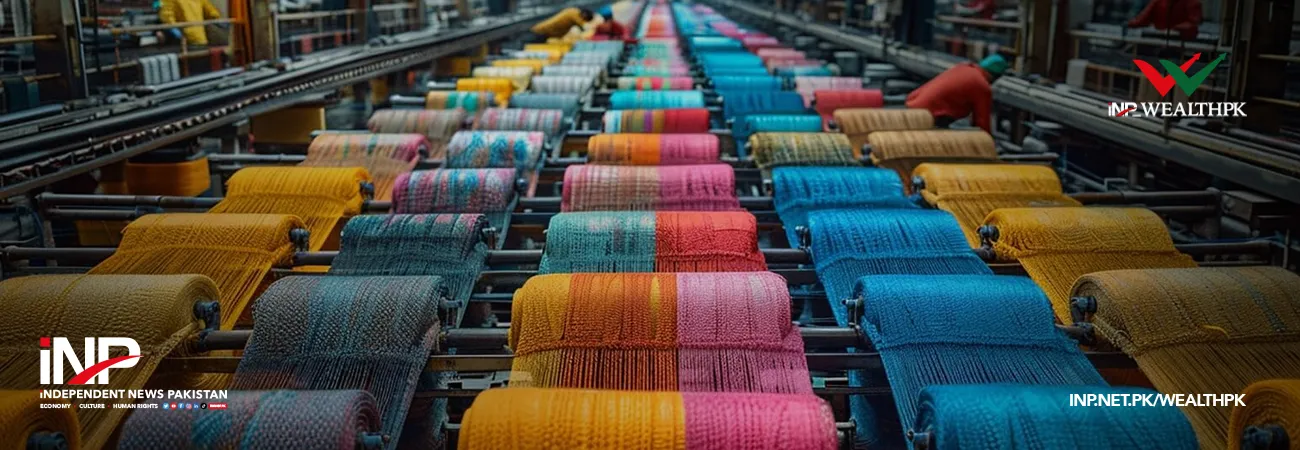
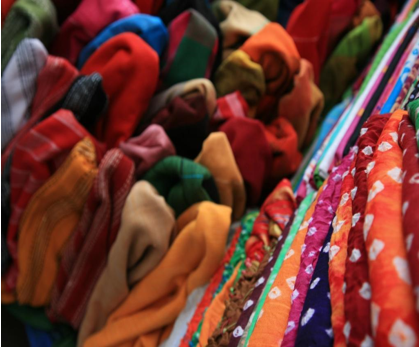
According to the official documents available with Wealth Pakistan, the three textile categories alone brought in about $12.37 billion, or nearly 64 percent of the combined exports of these top 10 products.
Official figures covering FY22 to FY26 show that knitwear remained Pakistan’s largest export product, although earnings fluctuated from $5.121 billion in FY22 to $4.437 billion in FY23 and $4.408 billion in FY24. Knitwear exports rebounded to $5.010 billion in FY25 before easing slightly to $4.966 billion in FY26.
Readymade garments showed a stronger upward trajectory in recent years. Their exports stood at $3.905 billion in FY22, declined to $3.492 billion in FY23, and then rose to $3.564 billion in FY24, $4.129 billion in FY25, and $4.288 billion in FY26.
Bedwear exports, meanwhile, fell from $3.293 billion in FY22 to $2.692 billion in FY23 before recovering to $2.803 billion in FY24 and $3.113 billion in FY25. They remained unchanged at $3.113 billion in FY26.
Rice exports displayed greater volatility, surging from $2.149 billion in FY23 to $3.932 billion in FY24, before falling to $3.353 billion in FY25 and $2.292 billion in FY26. Conversely, cotton cloth showed a persistent decline, dropping from $2.438 billion in FY22 to $1.672 billion in FY26.
Among other major products, towels generated $1.062 billion in FY26 compared with $1.111 billion in FY22. Leather manufactures stood at $576 million in FY26, while meat exports increased from $341 million in FY22 to $530 million. Fish and fish preparations rose to $482 million in FY26, while surgical instruments remained broadly stable at $452 million.
The concentration of leading exports in textiles and rice has prompted the government to pursue broader diversification measures. Under the National Tariff Policy 2025-30, tariffs on raw materials and intermediary goods are being reduced, while Additional Customs Duties and Regulatory Duties are planned to be abolished by 2030 to support industrialization and integration into global value chains.
The document further revealed that Pakistan has also initiated bilateral engagement with Türkiye in logistics, certification and market facilitation to strengthen service-sector exports. The proposed Pakistan-GCC Free Trade Agreement has reached an advanced stage of negotiations, while preferential trade agreements with Türkiye, Uzbekistan and Azerbaijan have been operationalized.
The EU GSP Plus Scheme continues to provide zero-duty access to 91 percent of Pakistan’s exports to the European Union. In the UK market, Pakistan has secured duty-free access for more than 94 percent of its export products under the Developing Countries Trading Scheme (DCTS).
Regional connectivity is also being strengthened through transit trade arrangements with Afghanistan, Uzbekistan and Tajikistan.
The government is also reviewing existing trade agreements with Malaysia and Indonesia as part of efforts to improve their terms and align them with changing market conditions, indicating a wider push to expand Pakistan’s export base beyond its traditionally dominant products.
Credit: INP-WealthPk