


INP-WealthPk

Pakistan can boost industrial competitiveness by drawing on China's circular economy experience
July 23, 2026
By Azam Tariq
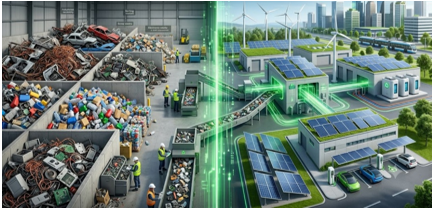
Pakistan can strengthen its industrial competitiveness by adapting China's circular economy model, which has transformed waste into a trillion-yuan industry while improving resource efficiency and supporting low-carbon economic growth, experts say.
The opportunity gained renewed attention after China's National Development and Reform Commission (NDRC), the country's top economic planning agency, unveiled its circular economy roadmap under the 15th Five-Year Plan (2026-30). The strategy aims to build a resource-recycling industry worth 8 trillion yuan (about $1.2 trillion) by 2030 and achieve a globally leading level of resource efficiency by 2035, supporting China's goal of peaking carbon emissions before 2030.
For Pakistan, the relevance is immediate. According to the Sustainable Development Policy Institute (SDPI), the country generates nearly 49.6 million tonnes of solid waste annually, yet less than 20 percent is formally collected and only a small fraction is recycled. Experts say these growing waste streams should be viewed not merely as an environmental burden but as valuable industrial resources capable of generating energy, creating jobs and supporting export-oriented manufacturing.
Speaking to Wealth Pakistan, Engineer Asad Mahmood, energy efficiency expert and chief executive officer of ESG Nexus and Global Tech Innovations, said Pakistan must stop treating the circular economy solely as an environmental or recycling issue.
"It should instead be integrated into industrial policy, supported by incentives, formal value chains and sector-specific strategies for cleaner production," he said.
Mahmood said adopting green technologies could lower industrial energy costs, reduce emission intensity and improve the competitiveness of Pakistani manufacturers in international markets. However, he stressed that resource-efficient production must be accompanied by workforce development and internationally recognised certification.
"If we want value addition, we will require skill sets and international certification at localised cost," he said.
Highlighting China's experience, Mahmood said the country's success stemmed from embedding circular economy principles into national industrial planning. He cited Qingdao Port, where solar tracking systems have improved power generation efficiency by about 40 percent, and Moon Environment Technology Company, whose industrial carbon capture technologies now exceed 12 million tonnes of annual carbon capture capacity.
Dr Muhammad Ziad, Manager of Solid Waste Management at Water and Sanitation Services Peshawar (WSSP), told Wealth Pakistan that Pakistan's nearly 49 million tonnes of municipal waste each year could become an important source of energy through waste-to-energy (WtE) facilities that utilise non-recyclable combustible waste.
He said cities first need effective waste segregation at source and material recovery facilities to separate recyclable and organic waste, leaving high-calorific residual waste for technologies such as mass-burn incineration, refuse-derived fuel (RDF) and anaerobic digestion.
According to Ziad, commercial viability will depend on a dedicated national framework that includes supportive tariffs, guaranteed power purchase agreements, long-term waste supply contracts, concessional financing, green bonds and carbon credit mechanisms.
He said China's rapid expansion of waste-to-energy projects demonstrates the importance of strong government backing, long-term planning and integrating waste management with national energy policy.
Umair Rahman, Associate at the Office of the Coordinator to the Prime Minister on Climate Change and Environmental Coordination, told Wealth Pakistan that China's most valuable lesson for Pakistan lies in its institutional approach.
"China embedded circular economy principles into national planning, coordinated implementation across ministries, and used the state itself as a strategic investor and market-maker," he said.
Rahman noted that Pakistan already possesses an important policy foundation through its Nationally Determined Contributions (NDCs) and the Pakistan Green Taxonomy. According to the Ministry of Climate Change and Environmental Coordination, NDC 3.0 and the Pakistan Green Taxonomy were among its key policy publications in 2025, while the State Bank of Pakistan (SBP) has advised banks and development finance institutions (DFIs) to use the taxonomy as a reference framework for developing green banking policies.
He said renewable energy, green hydrogen, carbon capture, biodegradable materials and electric transport could support higher value-added industrial growth. He urged Pakistan to channel its expanding solar capacity towards industry, create dedicated green credit facilities for small and medium-sized enterprises (SMEs), and use the China-Pakistan Economic Corridor's (CPEC) green corridor to facilitate technology transfer rather than relying solely on hardware imports.
Experts believe Pakistan can draw valuable lessons from China's experience by treating waste as an economic resource rather than a disposal challenge. With consistent policies, investment and institutional coordination, a circular economy could help improve industrial competitiveness while advancing the country's environmental, energy and economic objectives.
Credit: INP-WealthPk