



INP-WealthPk
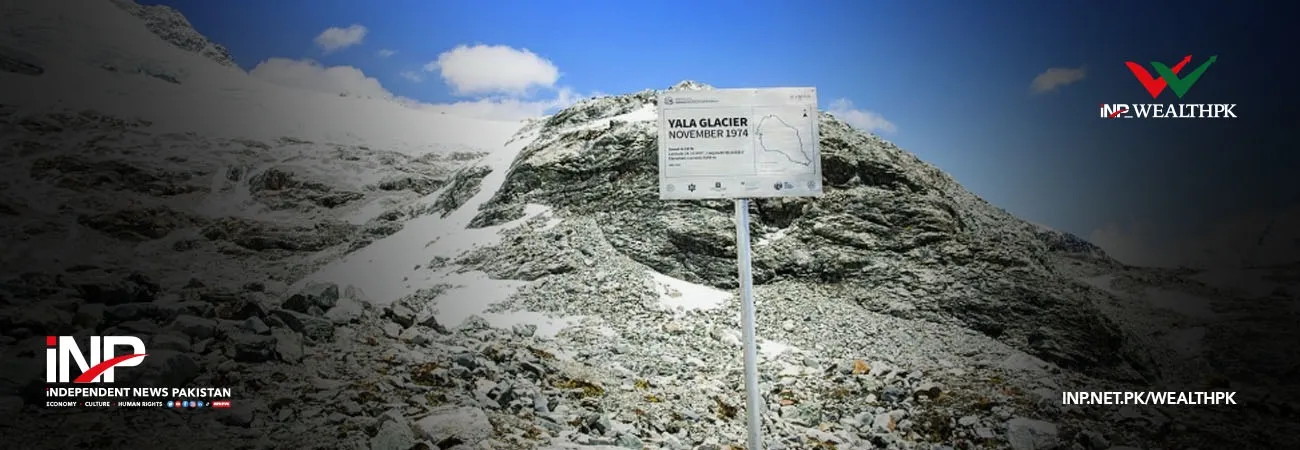
Only 38 of 63,700 HKH glaciers under field monitoring
October 14, 2026
By Azeem Ahmed Khan
Only 38 of approximately 63,700 glaciers in the Hindu Kush-Karakoram-Himalaya (HKH) region are under field monitoring, representing less than 0.06% observational coverage and highlighting the need for expanded glacier surveillance and stronger early warning systems.
According to documents of the Ministry of Climate Change and Environmental Coordination available with Wealth Pakistan, the Karakoram remains one of the least-studied mountain ranges globally, while gaps in monitoring pose challenges to assessing Glacial Lake Outburst Flood (GLOF) risks.
The documents recommend strengthening early warning systems in high-risk mountain regions by installing, assessing and improving the operational readiness of GLOF early warning systems.
They also call for updating and harmonising glacial lake inventories and hazard maps using satellite imagery and drone-based surveys for real-time tracking.
Another recommendation is to integrate rainfall and runoff, temperature and glacial lake dynamics into predictive, impact-based early warning models to strengthen data-driven forecasting.
The documents identify outdated baseline inventories as another challenge. The widely cited 2013 inventory covering 3,044 glacial lakes is now more than a decade old, while newer EvK2-CNR/ICIMOD inventories need to become the standard reference.
Satellite monitoring also faces cloud-cover blind spots, with persistent cloud cover limiting cloud-free satellite acquisitions during parts of the melt season.
Early warning coverage has expanded under GLOF-II, which covers 24 priority valleys. However, the documents note that many valleys adjacent to potentially dangerous glacial lakes outside this footprint still lack community-based early warning systems.
The recommendations therefore call for village-level monitoring and alert networks, awareness campaigns and stronger preparedness capacity in high-risk settlements.
They also propose enforcing no-build zones, developing hazard-informed evacuation protocols and deepening collaboration with national and international partners and academia.
Recent GLOF events cited in the documents underscore the importance of improved monitoring. The Hassanabad event in July 2025 occurred without significant rainfall, showing that glacial instability itself can trigger a GLOF with minimal warning.
The documents also identify recurring hotspots. Shisper Glacier recorded GLOF events in 2018, 2020, 2022 and 2025, while Ghizer District experienced events in August 2025 and July 2026, indicating repeated incidents at the same locations.
During the 2025 season, concurrent GLOFs and cloudbursts struck Gilgit-Baltistan and Chitral, straining emergency response capacities.
The Ghizer River blockage in August 2025 also demonstrated the potential for secondary flooding. The documents noted that a GLOF can create a second, delayed flood hazard when a blockage fails.
In Ishkoman Valley, a July 2026 event was flagged in advance by the National Disaster Management Authority and Pakistan Meteorological Department, but major settlement damage still occurred.
Data integration is another area identified for improvement, as datasets maintained by different organisations are not yet available through a single shared real-time platform.
The documents also stress the need for sustained financing, recommending a recurring budget line for operation and maintenance of sensors, weather stations and early warning infrastructure rather than reliance on one-off donor funding.
Strengthening field monitoring, updating glacial lake inventories, expanding early warning coverage and improving community preparedness are among the key measures recommended to enhance GLOF risk management in vulnerable mountain regions.
Credit: INP-WealthPk
Related Articles