




INP-WealthPk

Global energy shocks shift focus from fuel diversification to resilience
October 15, 2026
By Ayesha Saba
Diversifying fuel suppliers alone is no longer sufficient to protect economies from major energy shocks, as disruption to critical shipping routes increasingly requires countries to combine strategic reserves, domestic production, stronger infrastructure and alternative energy sources, according to experts.
The trend has gathered momentum after the 2026 Middle East conflict severely disrupted energy flows through the Strait of Hormuz, exposing the risks faced by economies heavily dependent on imported oil and liquefied natural gas (LNG).
Before the crisis, LNG moving through the Strait accounted for almost 20% of global LNG supply. The route also carried nearly 20 million barrels per day of oil in 2025, with around 80% of seaborne oil flows through the Strait destined for Asia.
The International Energy Agency (IEA) said in a recently released report that recent crises had challenged long-standing assumptions about gas security and strengthened the case for physical reserves, flexible commercial arrangements and emergency-response mechanisms.
The agency said competition for limited LNG cargoes during periods of exceptionally tight supply could trigger extreme price volatility and, in some cases, still fail to prevent physical shortages.
The disruption has broadened the concept of energy security beyond simply securing fuel contracts.
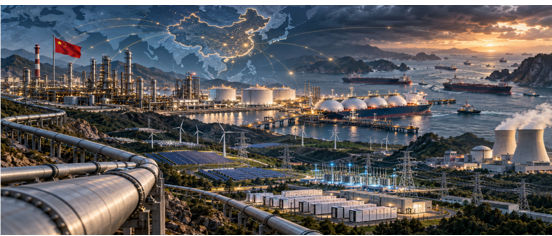
China has emerged as one of the clearest examples of a broader resilience strategy. Under its new oil and gas development plan for 2026-30, Beijing aims to raise domestic oil and gas supply to 440 million tonnes of oil equivalent by 2030 and add about 20,000 kilometres of long-distance pipelines, taking the country's oil and gas pipeline network to around 220,000 kilometres.
China also plans to raise natural-gas reserve capacity to more than 13% of national consumption, alongside efforts to diversify international energy cooperation and increase domestic production.
According to the data, China's crude imports were down 14.6% year-on-year at 320.9 million tonnes during January-August. At the same time, renewable energy accounted for around 60% of China's installed power-generation capacity by the end of 2025, giving the economy a broader energy base from which to respond to international fuel disruptions.
By the end of July, China's installed power-generation capacity had reached 4.08 terawatts (TW), up 11% year-on-year, including 1.29TW of solar and 690GW of wind.
Renewable capacity had already reached 2.455TW by mid-year, accounting for 60.7% of total installed capacity. Nuclear power is also being expanded alongside renewables to provide firm, low-carbon generation.
The National Energy Administration said China has 57 approved nuclear units under construction, while operating and approved-under-construction nuclear capacity has reached 135GW.
Talking to Wealth Pakistan, Dr Hassan Daud Butt, Senior Advisor at China Energy Engineering Group, said China's response suggested that diversification alone was not enough when major shipping routes or producing regions were disrupted.
“Strategic storage, domestic production, pipelines, LNG infrastructure and renewable generation together provide a much stronger buffer against external shocks,” he said.
Butt maintained that developing economies with high fuel-import dependence and limited storage capacity remained especially exposed to sudden commodity and freight-price shocks.
He said the approach would also require Pakistan to address weaknesses in its own energy infrastructure.
China has already developed a substantial presence in Pakistan's energy sector, and the relationship is gradually moving towards deeper commercial cooperation through joint ventures, equity participation, technology partnerships and local industrial collaboration.
“This creates an opportunity for Pakistan to move beyond project-based engagement and build longer-term partnerships with Chinese companies in areas such as energy storage, grid technologies, renewable-energy equipment and local manufacturing,” Butt said.
Speaking to Wealth Pakistan, Areeba Arif, Research Associate at the Institute of Strategic Studies Islamabad, said Pakistan should increasingly look beyond importing finished renewable-energy systems and use cooperation with China to build domestic production and technological capabilities.
She said the next phase of China-Pakistan Economic Corridor energy cooperation could consequently move beyond conventional power-generation projects towards the infrastructure and technologies required for a more flexible and resilient electricity system.
Greater localisation, she said, could enable Pakistan to capture more economic value from the energy transition through local manufacturing, technical skills, engineering services and stronger supply chains instead of remaining predominantly a market for imported equipment.
Credit: INP-WealthPk