



INP-WealthPk
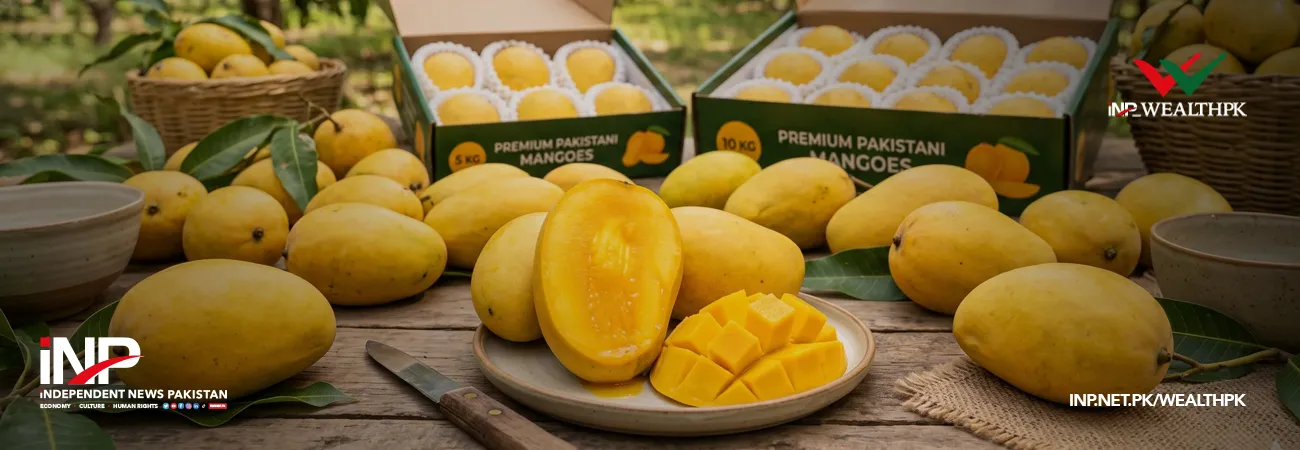
Better post-harvest handling can boost Pakistan’s mango export value: expert
August 11, 2026
By Azeem Ahmed Khan
Pakistan exports mangoes to more than 40 countries; however, better harvesting, grading, packaging, ripening and quarantine treatment can further boost export value and enhance competitiveness in high-end markets, says a mango expert.
Talking to Wealth Pakistan, Dr Muhammad Amin, Associate Professor of Horticulture/Postharvest at the Islamia University of Bahawalpur, said Pakistan must keep focusing on exports and production, as many other countries have strengthened their position in the global mango market by improving their systems. The horticulture expert has been working on mangoes for over 20 years.
He cited Cambodia, Vietnam and Ecuador as examples of countries developing their mango sectors, stressing that Pakistan needs to address export issues to increase both volume and value.
According to the IUB associate professor, Pakistan’s mango export practices have improved significantly over the last two decades, particularly in harvesting, de-sapping, processing and packing according to market requirements. However, fruit fly, post-harvest diseases, food safety, chemical residues, microbial activity, shelf life and shipping life remain major challenges.
He said quality remains central to market success because international buyers demand ripe but firm fruit, uniform colour, standard size, attractive packaging, proper labelling, traceability, at least one week of shelf life and protection from physical, chemical or biological contamination.
The mango specialist said the value chain requires skilled labour and proper standards from production to harvest and post-harvest handling. He pointed out that defects such as fruit fly, disease inoculum, scale problem, sunburn, scab and internal breakdown begin at the field level, while sap damage, punctures and bruises occur during harvesting and handling.
He urged the Pakistan Horticulture Development and Export Company to develop a uniform farm-level standard so growers can produce and harvest mangoes of consistent quality. Production practices, he said, vary widely from orchard to orchard, creating differences in the final product.
On harvesting, the expert said future plantations should shift towards small-tree systems so fruit remains within hand reach and damage is reduced. Where trees are large, farmers should use ladders, elevators and poles carefully to prevent fruit from falling, getting punctured or being damaged.
He said post-harvest handling must also improve at farm level. Fruit should be handled in the shade, plastic bins should not be overfilled, and bins must be washed regularly to prevent contamination. For export, he recommended physical de-sapping and lime wash, while noting that physical de-sapping is presently the best method.
The horticulture expert also called for better on-farm transportation, saying uneven roads, overloaded trolleys and vehicles without proper shock absorption cause bruises when fruit jumps during movement. At pack houses, he said labour-intensive handling should be supported by mechanisation, and fruit should be placed softly on conveyor belts.
He said Pakistan already has processing systems, including washing, hot water treatment, fungicidal dip treatment, sponge drying, hot air drying, grading and packing. However, manual grading still limits uniform presentation in international markets. He stressed the need to integrate manual systems with mechanical grading and packaging so that fruit size, colour and presentation become more consistent.
For quarantine treatment, he said mango exports require options such as hot water treatment, vapour heat treatment and irradiation. Extended hot water treatment is used to control fruit fly, while Japan mandates vapour heat treatment. Pakistan, he added, needs to further improve treatment facilities, including a stronger focus on irradiation.
The associate professor said labelling is another important area because it gives buyers information about product weight, grade, usable days, price and source. QR codes can also be used to provide product information digitally.
He warned against improper ripening practices, saying mangoes should not be ripened with calcium carbide, which is banned for causing cancer. Instead, ethylene gas, ethylene sachets or liquid ethephon should be used.
Credit: INP-WealthPk