



INP-WealthPk
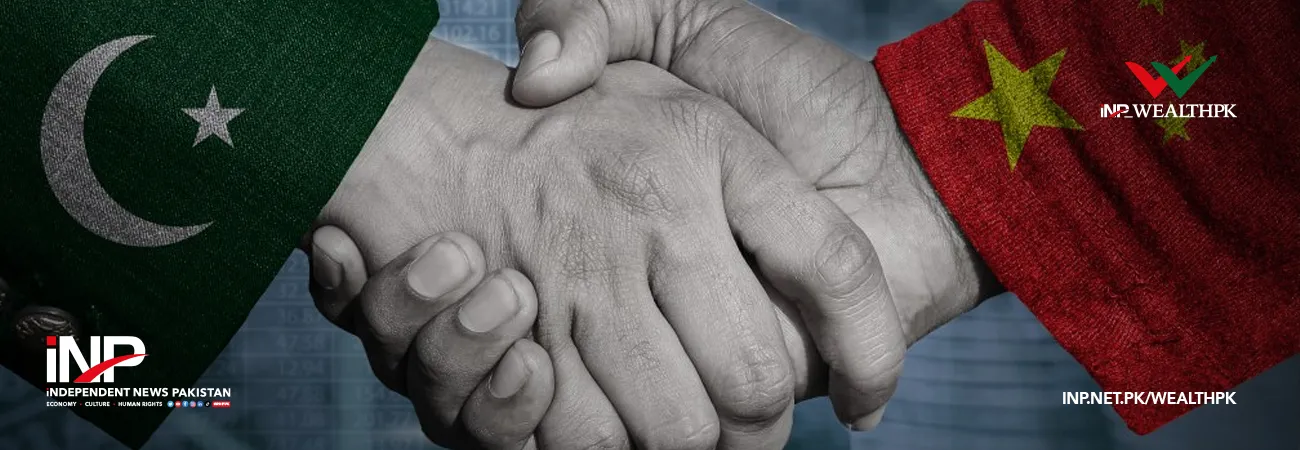
Pakistan-China chemicals partnership expected to boost industrial competitiveness
June 03, 2026
By Hasan Salahuddin
Pakistan’s chemicals and dyes sector is expected to gain fresh momentum following a new cooperation agreement with China that industry experts believe could strengthen domestic manufacturing, support technology transfer and improve export competitiveness.
In a major development for the industrial sector, the Pakistan Chemicals & Dyes Merchants Association (PCDMA) signed a Memorandum of Understanding with the China Council for the Promotion of International Trade (CCPIT), formalising bilateral cooperation in chemicals and dyes.
The MoU was signed on the sidelines of China InterDye 2026 in Shanghai, with PCDMA Chairman Salim Valimuhammad and CCPIT Chairman Yuan Junjie describing the agreement as an important step in expanding industrial cooperation between the two countries.
The development comes at a time when Pakistan’s industrial sector continues to rely heavily on imported chemicals despite the central role of manufacturing exports in the economy.
According to the Pakistan Bureau of Statistics, textile group exports reached $17.887 billion during FY2025, accounting for 55.83% of total goods exports and maintaining the sector’s position as Pakistan’s largest export earner.
However, Pakistan’s domestic chemicals sector remains significantly dependent on imports. According to the Pakistan Credit Rating Agency Limited (PACRA), chemical imports reached Rs1,522 billion in FY2025, representing around 7.6% of the national import bill, while exports stood at only Rs76 billion.
The large gap between chemical imports and exports highlights the need to strengthen local industrial capabilities, particularly in chemical inputs used by textiles, leather and manufacturing industries.
Speaking with Wealth Pakistan, Dr Tanveer Hussain, Professor of Textile Engineering at National Textile University Faisalabad, said stronger Pakistan-China cooperation in chemicals and dyes could improve industrial productivity by increasing access to advanced chemical inputs, technical expertise and more efficient supply chains.
He said such cooperation could help improve product quality, process consistency, energy efficiency and resource utilisation while reducing production lead times for export-oriented sectors such as textiles, leather and manufacturing.
Dr Hussain noted that the broader opportunity extends beyond trade in raw materials.
According to him, structured cooperation with China could support technology transfer in specialty chemicals, cleaner production methods, industrial automation, testing systems, digitalisation and workforce development, helping Pakistan gradually move toward higher-value manufacturing.
However, he stressed that sustainable gains would depend on developing domestic capabilities rather than merely increasing import dependence.
“The real success metric is local value addition, joint ventures, technical upgrading, knowledge transfer and export diversification,” he said.
Dr Kashif Iqbal, Associate Professor at the Department of Textile Engineering at National Textile University Faisalabad, said collaboration with China in chemicals and dyes could significantly help Pakistan strengthen industrial productivity, improve export competitiveness and establish a more reliable supply chain for the textile and leather sectors.
“At present, Pakistan has a limited number of dyestuff manufacturing units, and the textile sector depends heavily on imported dyes and chemicals,” he said.
He added that industrial collaboration and joint ventures with China could help strengthen Pakistan’s domestic dyestuff industry through technology transfer, technical expertise and advanced manufacturing practices.
Dr Iqbal further said China’s extensive expertise in specialty chemicals, high-performance dyes and large-scale production systems offers important opportunities for Pakistan.
According to him, technology transfer could increase domestic production capacity, reduce reliance on imports and improve the competitiveness of Pakistan’s manufacturing sector.
He added that stronger cooperation could also help Pakistan meet domestic industrial demand and support export expansion over the long term.
Muhammad Abeel Farzand, Technical Specialist at Transfar Chemicals Group, also highlighted the strategic importance of the partnership.
“Chemicals and dyes are essential inputs for Pakistan’s major export sectors, particularly textiles and apparel,” he said, adding that enhanced cooperation with China could provide a dependable and cost-effective supply of quality raw materials.
Farzand said technology exchange could also help modernise Pakistan’s manufacturing base through advanced and environmentally sustainable dyeing technologies and more efficient wastewater management systems.
He pointed to ongoing industrial activity, including large-scale manufacturing projects by companies such as Challenge Fashion Group in Punjab, as indicators of growing industrial potential.
He added that establishing local manufacturing joint ventures through technology partnerships could support a more self-reliant supply chain, strengthen value addition and improve export prospects while easing pressure on Pakistan’s import bill.
Industry experts believe the PCDMA-CCPIT agreement could help create opportunities for technology transfer, industrial upgrading and stronger domestic capability, supporting Pakistan’s long-term objective of building a more competitive and value-added manufacturing sector.
Credit: INP-WealthPk
Related Articles