

i INP-WEALTHPK
US credibility concerns, Western rift over Iran add to Pakistan’s economic risksتازترین
April 08, 2026
By Moaaz Manzoor
Concerns over US credibility as a reliable partner, coupled with a widening split between Washington and its Western allies over the Iran conflict, are increasing economic risks for countries like Pakistan, where shifts in global energy prices and trade uncertainty quickly translate into inflationary pressures and a higher import bill, reports Wealth Pakistan.
The emerging divide is not only exposing cracks in Western coordination but also raising questions about the ability of major powers to manage and contain crises effectively. For markets, credibility and coordination are critical signals. When they weaken, uncertainty over oil supplies, shipping routes, and insurance costs tends to rise, particularly in already volatile regions like the Gulf.
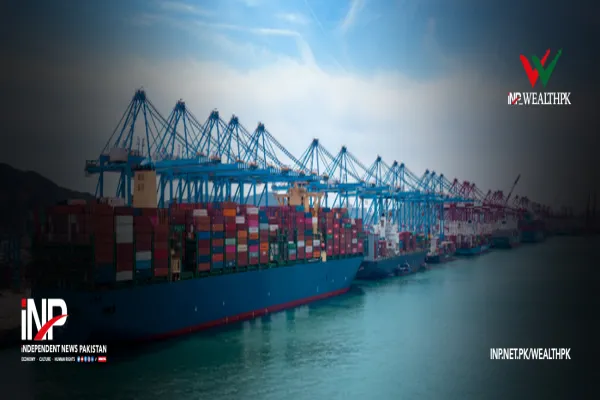
At the centre of these risks is the Strait of Hormuz, one of the world’s most vital energy corridors. As tensions around the waterway intensified, Washington pushed for stronger allied support on military access and maritime security. However, several European countries responded cautiously, resisting deeper involvement and limiting direct support. This hesitation has economic implications, as markets react not only to the conflict itself but to the likelihood that major powers can coordinate a stable response. When that coordination appears fragile, the perceived risk of supply disruption increases, driving volatility in oil prices and freight costs.
The political fallout has further reinforced these concerns. US President Donald Trump publicly criticised allies he viewed as unwilling to support Washington more forcefully, even suggesting a potential withdrawal from NATO. Secretary of State Marco Rubio also questioned the value of transatlantic arrangements that, in his view, offer insufficient reciprocity. Such rhetoric has deepened perceptions of a fragmented Western alliance, adding to market unease and weakening confidence in collective crisis management.
For Pakistan, the economic impact is already visible. According to a research report by AKD Securities, inflation in March 2026 was projected to rise 7.3% year-on-year and 1.2% month-on-month, driven largely by higher fuel costs linked to the Middle East conflict. The report noted that transport and housing would bear the brunt as rising international oil prices filtered into the domestic economy, despite government efforts to cushion the impact through subsidies.
AKD projected the transport index to rise 19.5% year-on-year and 18.7% month-on-month in March, while the housing index was expected to increase 11.3% year-on-year and 1.4% month-on-month. It also pointed to higher liquefied hydrocarbons prices amid supply disruptions tied to tensions around the Strait of Hormuz. This underscores how geopolitical instability in the Gulf is directly feeding into fuel, transport, and utility costs in Pakistan.
The risks extend beyond inflation. A study by the Pakistan Institute of Development Economics (PIDE), titled Managing Oil Shocks: Pakistan’s Fiscal Risks and Policy Choices, warns that a sustained oil shock linked to the Israel-US-Iran conflict could undermine Pakistan’s fiscal consolidation efforts. The study estimates that the federal primary surplus, budgeted at Rs1,706 billion (1.3% of GDP), could shrink to Rs1,002 billion (0.7% of GDP) under a moderate $100 per barrel scenario, to Rs821 billion (0.6% of GDP) under a severe $120 scenario, and to Rs781 billion (0.6% of GDP) in an extreme $144 scenario. At the same time, the fiscal deficit could widen from Rs6,501 billion (5.0% of GDP) to Rs7,517 billion (5.8% of GDP).
Speaking to Wealth Pakistan, Syed Basim Raza, Assistant Manager Research at the National University of Sciences and Technology (NUST), said Pakistan remains particularly vulnerable due to its heavy reliance on imported energy. Prolonged instability in the Middle East or disruptions in key shipping lanes, he noted, would directly increase the country’s import bill and intensify inflationary pressures through higher fuel and freight costs.
The broader concern is that the conflict is revealing a deeper shift in the international order. Zaeem Hassan Mehmood, a senior researcher at Greenwich University Karachi, said credibility is not just about power, but also about predictability and alignment with shared interests. When major decisions appear unilateral or insufficiently coordinated, allies become less willing to align fully, increasing the likelihood of prolonged volatility. For markets, such fragmentation raises the risk premium on energy and trade flows.
Pakistan’s financial markets have already reflected some of this pressure. In a separate strategy note, AKD Securities said higher oil prices and uncertainty around the Strait of Hormuz contributed to the worst monthly and quarterly performance of the KSE-100 index in six years. The index declined 12.6% in March 2026, while trading volumes fell 36.8% to 652 million shares, and traded value dropped 32% month-on-month to Rs36.2 billion.
Despite these challenges, the evolving situation may also present a limited diplomatic opportunity. AKD noted that Pakistan’s potential role as a mediator in the US-Iran conflict could improve its standing in the Gulf and support foreign investment if tensions ease. However, this remains a secondary possibility. In the near term, as long as the Iran conflict continues to expose divisions within the West and raise doubts about the coherence of the US-led response, Pakistan is likely to remain vulnerable to imported inflation, fiscal stress, and external shocks.
Credit: INP-WealthPk
متعلقہ خبریں