


i NEWS PAK-CHINA
Pakistan’s Seafood exports to China rise 41%Breaking
August 23, 2026
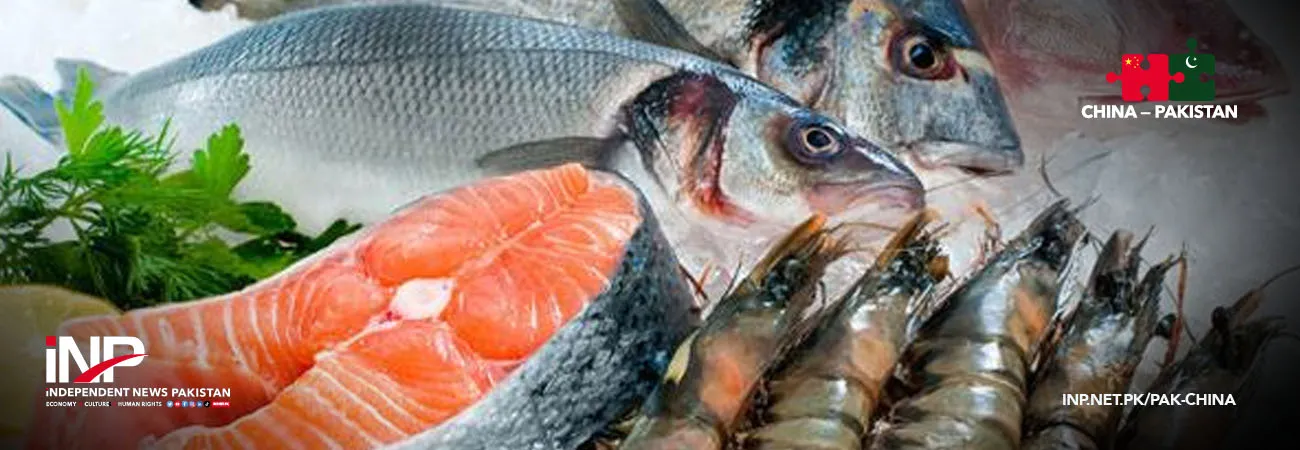
Pakistan’s seafood exports to China reached $220 million in the first seven months of 2026, marking a robust 41 percent year-on-year increase from $156 million in the same period of 2025, as per the latest data from the General Administration of Customs of China (GACC).
The trade basket reflected strong Chinese demand across a broad spectrum of marine varieties, led by frozen fish, cephalopods, and live crustaceans, China Economic Net (CEN) reported on Sunday.
Miscellaneous frozen whole fish (HS 0303.8990) constituted the largest single category, generating $40.04 million on shipments of 19,834 metric tons.
Frozen cuttlefish and squid varieties (HS 0307.4390 and HS 0307.4310) contributed a combined $36.39 million, underscoring high consumption in Chinese culinary and processing sectors.
Frozen sardines and sprats (HS 0303.5300) yielded $19.49 million (22,458 metric tons), while live and chilled mud crabs (HS 0306.3399) fetched $18.70 million.
Other prominent export items included frozen octopus ($9.16 million), frozen fish fillets and meat ($7.71 million), frozen shelled shrimps and prawns ($6.86 million), and frozen flatfish ($5.71 million).
China’s southern and eastern coastal gateways served as the primary landing hubs for Pakistani marine cargo.
Fujian emerged as the leading destination, absorbing $32.58 million (21.14% share) to supply its extensive seafood processing, canning, and re-export industries.
Guangdong ranked second, importing $27.50 million (17.84% share), driven largely by high consumer demand in the Greater Bay Area for fresh and live marine species.
Shandong and Zhejiang accounted for $22.88 million (14.85%) and $22.04 million (14.30%) respectively, while Shanghai ($13.30 million) and Yunnan ($11.21 million) recorded steady inflows.
Muhammad Imran, Trade and Investment Counsellor at the Pakistan Consulate Guangzhou, told China Economic Net that around 200 Pakistani seafood exporters and 10 fish-meal producers now hold formal registration with China's customs authority, widening the base of companies legally able to ship directly to Chinese buyers a shift that helps explain the outsized jump in fish-meal exports.
He further said that the second phase of the China-Pakistan Free Trade Agreement has extended zero- or reduced-tariff access to an expanded list of seafood species, with Pakistani exporters and GACC continuing to negotiate the addition of further species to the preferential list.
“Seafood has become one of the faster-growing non-textiles, non-copper categories in bilateral trade, complementing traditional exports such as cotton yarn and agricultural products.
Pakistan’s coastal fisheries and processing capacity are increasingly aligned with Chinese market requirements for quality and consistency”, he stated.
Credit: Independent News Pakistan (INP) — Pak-China
Related News