


i NEWS PAK-CHINA
Pakistani student wins third prize at International Youth River ExchangeBreaking
September 30, 2026
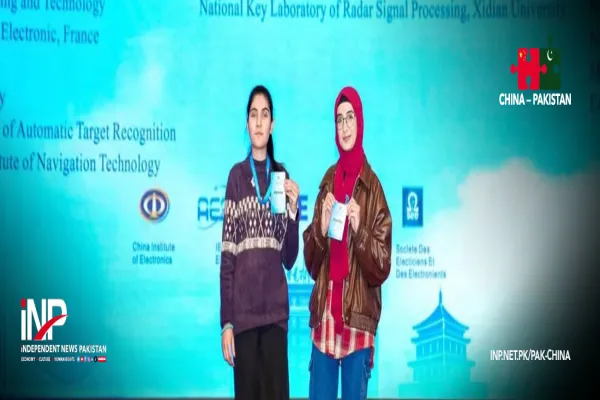
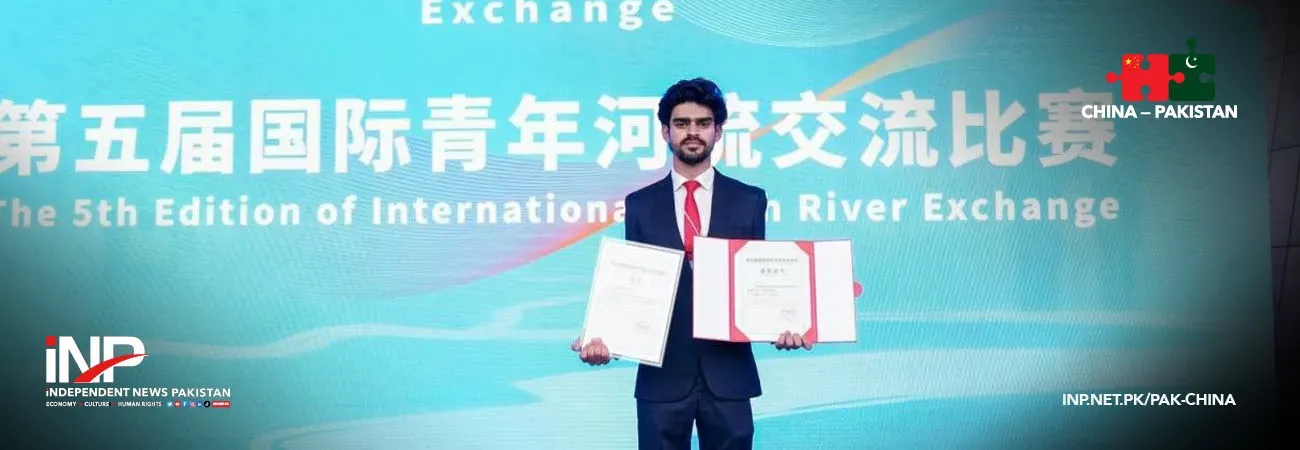
A Pakistani student pursuing Artificial Intelligence at the Nanjing University of Information Science and Technology (NUIST) won Third Prize among six finalists and was awarded the honorary title of “River Messenger” at the 5th International Youth River Exchange held on Sept 29 in Ningbo, Zhejiang province, China, where he highlighted the potential role of AI in sustainable river and irrigation management.
Guided by the Global Network of Water Museums, hosted by the National Water Museum of China, and organized by the Ningbo Museum of World Heritage Irrigation Structures, it brought together young student representatives from China, South Africa, Morocco, Indonesia, Pakistan and other countries for in-depth dialogue centered on “River and Irrigation”, Gwadar Pro reported on Wednesday.
Throughout its five-year history, the event has been encouraging university students to explore the deep connections between river ecology, water civilization and regional social, economic and cultural development, while spreading the concepts of water conservation and human-water harmony.
Pakistani student Azib Ali Buraq, drawing inspiration from the Yangtze River, which has become a familiar part of his student life in Nanjing, presented his topic “The River That Shaped Us.”
His presentation explored the historical and economic significance of rivers and irrigation while introducing an AI-based approach to modern water management.
At the center of his presentation was a proposed AI-integrated Yangtze River–Irrigation Management Model based on Digital Twin technology.
The proposed framework would integrate information from satellites, weather forecasts, environmental sensors, soil conditions, river conditions, reservoir levels and water demand data into a coordinated digital system.
AI could then analyze the information to support prediction, simulation and decision-making related to irrigation, reservoir operations, water supply and ecosystem protection.
Azib summarized the model through the sequence: “Sense → Predict → Simulate → Coordinate → Act → Learn.” Through the concept, he demonstrated how AI could potentially support authorities and stakeholders in analyzing different water management scenarios, including changes in rainfall, agricultural water demand and reservoir levels, enabling more informed and coordinated decisions.
As part of the program, participants conducted an on-site inspection of the Tuoshan Weir, a World Heritage Irrigation Structure, to experience firsthand the wisdom of water management and cultural legacy of the millennium-old engineering marvel.
For Azib, the visit provided an opportunity to examine how emerging technologies could complement traditional engineering knowledge rather than replace it.
He said the experience had further strengthened his interest in exploring practical applications of AI to complex global challenges.
Credit: Independent News Pakistan (INP) — Pak-China
Related News