


i NEWS PAK-CHINA
China-Pakistan team pioneers high-efficiency Solar Heat Pump SystemBreaking
December 10, 2025
A team of Pakistani and Chinese researchers has jointly developed a high-performance solar-assisted heat pump system that could reshape clean heating in colder regions and contribute to low-carbon development, according to a newly published peer-reviewed study in Energy (Elsevier), Volume 340, 2025.
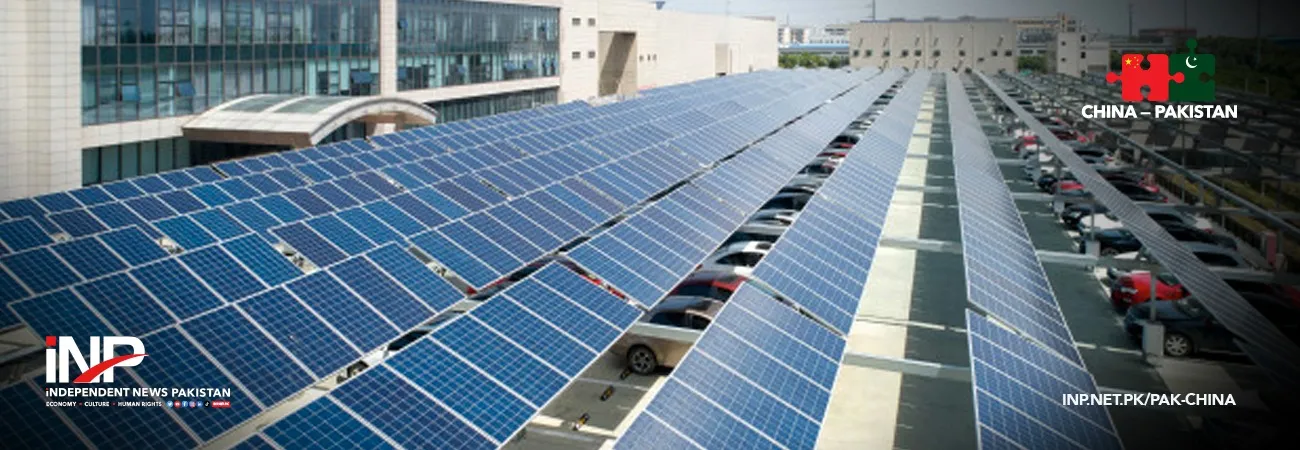
The collaborative research group, from Southwest Jiaotong University (China), the University of Engineering and Technology (Pakistan), and partner institutions, developed an indirect-expansion solar heat pump integrated with a parabolic dish concentrator and a high-concentration conical cavity tube receiver, Gwadar Pro reported on Wednesday.
According to the authors, combining a high-concentration solar receiver with an indirect heat-pump cycle is “a novel approach which has never been studied” and provides a sustainable path for efficient solar-heating applications. Testing conducted in China showed that the system achieved 65.35% thermal efficiency, 9.05% exergy efficiency, and a coefficient of performance (COP) of up to 4.86, significantly higher than conventional solar-heating systems.
The researchers explain that the parabolic dish concentrator focuses sunlight onto a small focal area, while the specially designed conical receiver improves heat capture and transfer. The study found that increasing the concentration ratio from 20 to 40 boosted thermal efficiency by 32%–71%, increased temperature lift by 10–18.5°C, and raised the COP from 3.86 to 5.4.
The model’s results were in close agreement with experimental testing. Lead author Dr. Sajid Abbas noted that the results offer a strong case for applying concentrated solar systems in cold-region heating. “Our system offers an innovative methodological and experimental basis for utilizing high-concentration solar thermal collectors in heat-pump applications,” he wrote in the paper.
According to the study, solar heat pumps are a promising route for decarbonizing heating in line with China’s climate commitments. The work supports China’s goals of peaking emissions by 2030 and achieving carbon neutrality by 2060 and aligns with international clean-energy objectives highlighted within global climate agreements.
The authors conclude that the integrated parabolic dish and indirect-expansion heat pump system provides “better thermal efficiency and higher temperature lift” than conventional designs, and can be scaled for residential, agricultural, and industrial applications. The research was supported by the China Postdoctoral Council, the Southwest Jiaotong University Foundation, and the Fundamental Research Funds for the Central Universities.
China and Pakistan are deepening environmental cooperation under the new Action Plan (2025–2029), which commits both sides to “strengthen communication and cooperation on environment and make joint contributions to the improvement of the environment in both countries and beyond,” and welcomes Pakistan’s participation in the BRI International Green Development Coalition.
Credit: Independent News Pakistan (INP) — Pak-China
Related News