




i INP-WEALTHPK

China’s major science facilities enter new phase under 2026–2030 planBreaking
March 14, 2026
By Special Correspondent
China’s major science and technology infrastructure projects are entering a new phase of development as the country advances its innovation agenda under the 15th Five-Year Plan period (2026–2030).
According to discussions earlier during the Two Sessions, the annual meetings of China’s top legislature and top political advisory body, scientists shared updates on several large-scale research facilities, including major telescopes and deep underground laboratories.
The outline of the 15th Five-Year Plan highlights the importance of continuing the construction and improving the use of these major scientific facilities to strengthen China’s research capacity.
Wang Chi, a deputy to the 14th National People’s Congress and an academician of the Chinese Academy of Sciences, said the development of major science infrastructure in China has entered a new stage.
He noted that planning for these facilities is shifting from a focus solely on basic research toward supporting both basic and applied scientific work. The approach is also evolving from individual projects toward collaborative clusters of facilities with improved management across their entire life cycles.
Wang also shared updates on the Chinese Meridian Project-Phase II, which he leads. The project passed national acceptance inspection in March 2025 and established what is described as the world’s most comprehensive ground-based regional monitoring network for space weather.
The project is expected to serve as the foundation for broader international collaboration. Plans during the 2026–2030 period include further integration of the project’s different phases, improving operational efficiency and expanding applications to enhance space weather monitoring and warning capabilities for spacecraft.
Jiang Peng, a deputy to the National People’s Congress and chief engineer of the Five-hundred-meter Aperture Spherical Radio Telescope (FAST), also outlined new developments related to the facility, widely known as the “China Sky Eye.”
Since becoming fully operational in 2020, FAST has produced a series of scientific findings. In January this year, the telescope helped an international research team identify key evidence related to the origin of fast radio bursts.
Jiang said plans are underway to upgrade the telescope through the development of a “Core Array.” The project involves constructing dozens of 40-meter antennas that will work together with the main telescope, significantly improving its resolution.
The upgrade project is currently undergoing final evaluation, with key technologies already developed and tested.
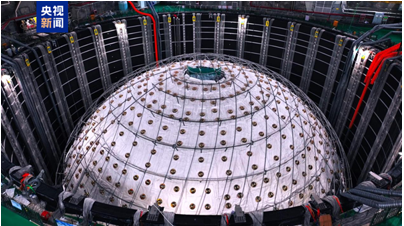
Another major facility highlighted during the discussions is the Jiangmen Underground Neutrino Observatory. Wang Yifang, a deputy to the National People’s Congress and the project’s manager, said the observatory produced its first physical results in November 2025.
The results measured two key parameters of neutrino oscillation with improved precision and exceeded the progress made by similar international experiments over the past decade.
Researchers expect that within the next three to four years, the experiment will determine the mass order of neutrinos, which remains one of the major unanswered questions in particle physics.
Looking ahead, scientists believe China’s space science infrastructure will enter a period of strategic transformation.
Wang Chi suggested that future space science facilities should be closely aligned with major national programs such as crewed lunar missions and the International Lunar Research Station. He also proposed establishing special programs to support forward-looking research into emerging scientific concepts, including space particle manipulation and next-generation space observatories.
Researchers working on these major facilities also stressed the importance of improving domestic technological capabilities while exploring applications that support national strategic priorities.
China’s ongoing investments in large-scale scientific infrastructure are expected to strengthen the country’s research capabilities and support further advances in fields ranging from space science and astrophysics to particle physics and technological innovation.
Credit: INP-WealthPk
Related News