



INP-WealthPk
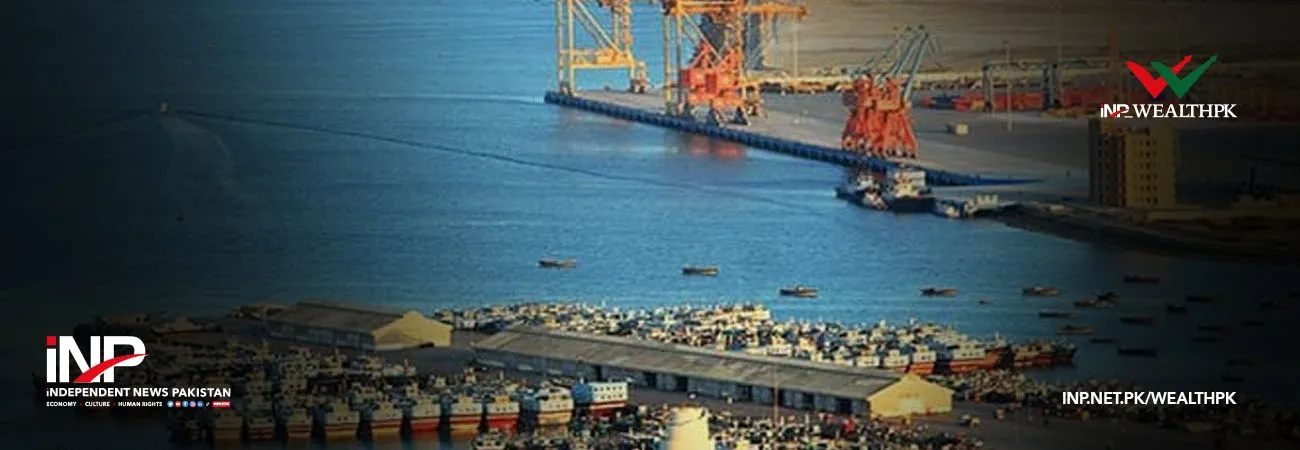
Tariff cuts at Gwadar Port seen boosting Pakistan’s trade competitiveness
May 25, 2026
By Ayesha Saba
The government’s decision to reduce tariffs at Gwadar Port is being viewed as a major opportunity for Pakistan’s maritime and logistics sector, with experts saying the move could improve trade competitiveness and stimulate economic activity across the region. Talking to Wealth Pakistan, Technical Advisor to the Ministry of Maritime Affairs Jawad Akhtar said Gwadar should not only be compared with ports in Dubai, noting that Pakistan’s ports, including Karachi Port and Port Qasim, are already comparatively more cost-effective than several Indian ports.
“Tariff reductions have not been limited to Gwadar alone. Charges at Karachi Port, Port Qasim, and Gwadar have all been reduced substantially, in some areas by nearly 50 to 60 percent,” he said. He added that the real significance of Gwadar would become more visible once major industrial and investment projects begin operations in the Gwadar Free Zone and adjoining economic zones. Highlighting steps taken to improve ease of doing business, Jawad Akhtar said customs-related costs had also been reduced considerably.
“Even scanning and clearance charges have been slashed by almost 50 to 60 percent to facilitate traders and lower logistics costs,” he noted. According to him, the government is also working to reduce port congestion and improve cargo handling efficiency through the development of off-dock terminals and additional storage facilities near ports. These facilities, he explained, would allow containers to remain in designated free areas for longer periods until onward shipping arrangements become available.
“The broader strategy is to make transportation faster, cheaper, and easier,” Jawad Akhtar said, adding that improved logistics and shipping facilitation could generate broader economic activity and encourage businesses to expand trade operations. He said the increasing frequency of shipping activity at Gwadar is gradually changing business perceptions about the port. “Earlier, perhaps only one ship arrived at Gwadar in a year, but now vessels are arriving almost every week.
This gives businesses confidence that trade opportunities are expanding,” he observed. Jawad Akhtar maintained that Gwadar Port currently faces no major security-related challenges. He further claimed that commercial activity in the port city has increased in recent weeks, with more businesses showing interest in the area and the property market also witnessing improvement. Referring to infrastructure development, he said the Government of Balochistan has recently floated a tender for a 40-megawatt power plant project for Gwadar, which is currently under procurement through the Board of Investment.
He said the initiative reflects the government’s continued focus on supporting industrial and commercial growth in the port city. Speaking to Wealth Pakistan, Dr. Khalid Waleed, Senior Research Fellow at the Sustainable Development Policy Institute (SDPI), said Gwadar’s location near key international shipping lanes gives Pakistan a natural advantage in serving as a gateway for transit trade to Central Asia, Afghanistan, western China, and the Gulf region.
He noted, however, that lower tariffs alone would not be sufficient unless accompanied by improvements in road infrastructure, customs procedures, cargo handling capacity, and security arrangements. “If implemented alongside broader infrastructure and policy improvements, Gwadar could evolve into a viable logistics node linking South Asia with Central Asia and beyond, strengthening Pakistan’s role in regional trade corridors,” he maintained.
Credit: INP-WealthPk