


INP-WealthPk
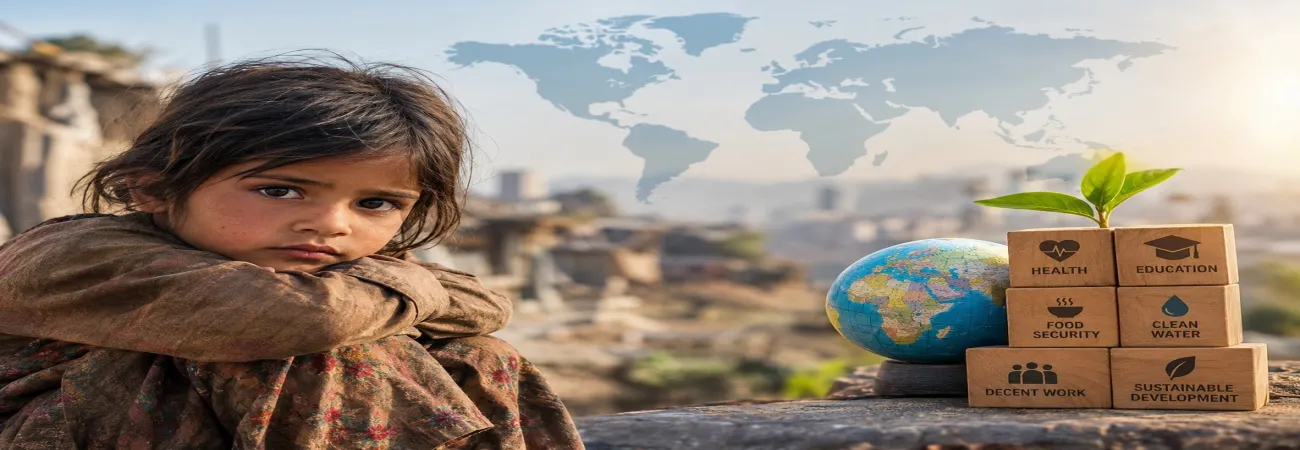
Rising global poverty reinforces need for targeted human development investment
November 11, 2026
By Abdul Wajid Khan
Rising multidimensional poverty worldwide has reinforced the need for developing countries to prioritise investment in healthcare, education, nutrition and social protection, as debt pressures, economic uncertainty and climate-related challenges continue to constrain progress in human development.
The findings of the 2026 Global Multidimensional Poverty Index, published by the United Nations Development Programme (UNDP), highlight the scale of these challenges, with approximately 1.2 billion people across 108 countries experiencing acute deprivation.
The figure represents 18.9% of the 6.3 billion people covered by the index and an increase of 51.5 million people compared with the previous update using comparable data. This marks the first rise in global multidimensional poverty since the index was launched in 2010.
The report shows that 534 million people face severe deprivation, while another 952 million are vulnerable to multidimensional poverty. Children account for 617 million of those living in poverty, highlighting the importance of sustained investment in essential services.
Rural communities face particularly significant challenges, with 83.3% of the multidimensionally poor population living in rural areas. The rural poverty rate stands at 28.7%, compared with 7% in urban areas.
In Pakistan, 38.3% of the population is classified as multidimensionally poor, while another 12.9% is vulnerable to such poverty. However, experts emphasise that these estimates must be interpreted in the context of the underlying survey period, with updated data needed to assess current conditions accurately.
The findings underscore the importance of policies that address persistent inequalities in access to healthcare, education and basic services, particularly as developing economies face mounting fiscal and environmental pressures.
Talking to Wealth Pakistan, Tassawar Anwar, a former government official and public policy analyst specialising in human development, poverty reduction and governance, said governments needed to develop policies suited to their socioeconomic conditions and address the underlying causes of deprivation.
He said the drivers of multidimensional poverty varied across countries, making it essential to design policy responses based on local circumstances and reliable research.
According to Anwar, conflict and its economic consequences, including displacement, job losses and inflation, could deepen deprivation, while political instability, natural disasters and climate change could further undermine living standards.
For Pakistan, he emphasised the importance of strengthening public services, improving access to healthcare and education, and taking targeted measures to address persistent gaps in basic living standards.
Anwar also stressed the need to interpret Pakistan's poverty estimates in the context of the data used to calculate them.
He said the estimates appeared to be based on the 2018-19 Pakistan Social and Living Standards Measurement (PSLM) Survey, adding that updated findings would be essential for assessing current poverty levels and developing evidence-based policies.
Maaz Ali, a researcher with a background in sustainable development, said rising inflation, debt-servicing pressures, conflicts and climate-related risks had contributed to the increase in global multidimensional poverty.
He said economic growth alone could not eliminate deprivation unless governments protected spending on healthcare, education and nutrition, particularly during periods of economic difficulty.
Developing countries, he added, needed stronger social protection systems, greater fiscal space and sustainable solutions to debt pressures to maintain investment in human development.
For Pakistan, Ali said persistent poverty reflected structural weaknesses in public service delivery, including the large number of out-of-school children, inadequate sanitation, reliance on unclean cooking fuels and child malnutrition.
He said a narrow tax base, heavy debt-servicing obligations and rapid population growth further constrained the government's ability to expand essential services and address development gaps.
Ali called for broadening the tax base, protecting health and education budgets, and directing public resources towards districts experiencing the greatest deprivation.
He said better-targeted cash assistance, alongside investment in nutrition, girls' education and sanitation, could help address persistent inequalities and improve living standards.
Ali emphasised that macroeconomic stabilisation and human development must advance together, as lasting poverty reduction required both economic stability and sustained investment in essential public services.
Meanwhile, the government of Pakistan is seeking to strengthen poverty measurement through a renewed partnership with the Oxford Poverty and Human Development Initiative (OPHI) to develop Pakistan's National Multidimensional Poverty Index (MPI) 2027.
According to an official statement issued by the Ministry of Planning, Development and Special Initiatives, Federal Minister Ahsan Iqbal and OPHI Director Professor Sabina Alkire signed the partnership to support more accurate poverty measurement and evidence-based development planning.
The initiative will draw on the Pakistan Social and Living Standards Measurement (PSLM) Survey 2026-27 and explore constituency-level poverty analysis using Census 2023 data.
Building on Pakistan's first National MPI, launched in 2016 in collaboration with OPHI and UNDP, the new initiative aims to strengthen the identification of deprived communities and improve the targeting of development resources.
The planned index could provide policymakers with a more detailed understanding of poverty across different regions, helping them identify gaps in healthcare, education and living standards and prioritise interventions accordingly.
As developing countries work to address rising multidimensional poverty, the combination of updated poverty measurement, targeted public spending and stronger social protection remains central to translating economic stability into lasting improvements in human development.
Credit: INP-WealthPk
Related Articles