

INP-WealthPk

Punjab expands vehicle emission checks to six cities ahead of smog season
October 15, 2026
By Muhammad Luqman
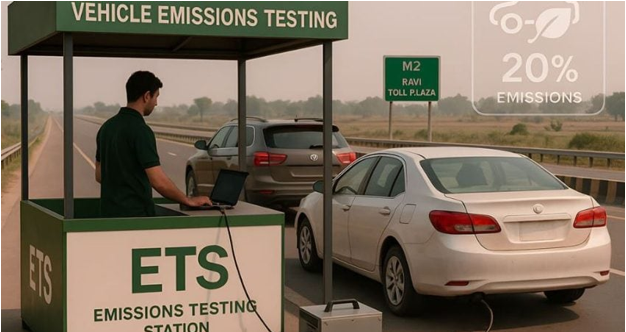
The Punjab government has launched a vehicle emission testing campaign in six cities across the province to curb automobile-induced air pollution ahead of the winter smog season, establishing 20 inspection centres for private vehicles under a new certification system.
According to official documents available with Wealth Pakistan, the government has established 14 Private Vehicle Inspection and Certification System (PVICS) centres in Lahore, two in Faisalabad and one each in Multan, Sargodha, Rahim Yar Khan and Sadiqabad.
The centres have been established in collaboration with private-sector workshops to assess vehicle emissions and ensure compliance with environmental standards.
The government has set November 15 as the deadline for obtaining and displaying vehicle fitness stickers. After the deadline, vehicles found operating without the required certification will face challans and possible penalties.
The initiative comes as Punjab prepares for the winter smog season, when emissions from vehicles, industrial facilities and brick kilns, along with crop residue burning, contribute to deteriorating air quality.
Automobile exhaust is estimated to contribute almost 43% of smog in Punjab during winter, making vehicle emission control an important component of the province’s air pollution management efforts.
Punjab has approximately 25 million registered vehicles, including around 2.5 million cars, highlighting the scale of the challenge facing authorities in controlling transport-related emissions.
The PVICS has been modelled on the Vehicle Inspection and Certification System (VICS), previously introduced by the Punjab government in collaboration with Opus Inspection (Pvt) Ltd for road safety and environmental protection.
Under the earlier system, a state-of-the-art computerised vehicle inspection and certification network was established to ensure that public service vehicles underwent regular inspections.
Public service vehicles are issued fitness certificates only after meeting prescribed safety standards and complying with environmental regulations governing noise and emissions.
The new campaign extends the focus to private vehicles, bringing a much larger segment of Punjab’s transport sector under emission testing and certification arrangements.
“Getting fitness certificates for vehicles is in the owners’ interest, as it will ensure that the vehicles are roadworthy as well as environmentally friendly,” Shiraz Ali, spokesperson for the Punjab Transport Department, told Wealth Pakistan.
He said this was the first time the Punjab Transport Department had been entrusted with testing vehicle emissions across the province.
Previously, the responsibility for conducting vehicle emission tests rested with the Environmental Protection Department, which mainly focused on major cities such as Lahore.
Ali said a fitness test was also mandatory for the sale and purchase of vehicles in Punjab.
Environmental experts believe that effective implementation of vehicle emission standards could help improve air quality in major urban centres, particularly Lahore and Faisalabad, where pollution levels typically rise during November and December.
Syed Naseemur Rehman Shah, a former director of the Punjab Environmental Protection Department, said the emission testing campaign could help reduce harmful pollutants if inspections were rigorous and environmental standards were properly enforced.
“The emission testing campaign may be helpful in bringing down the levels of nitrogen and sulphur gases in the air if it is carried out seriously and in letter and spirit,” he said.
Shah said the continuous increase in the number of vehicles in major cities such as Lahore had contributed to the thick layer of toxic air experienced during the winter months.
He stressed that the campaign should not be treated as a temporary response to seasonal smog but should become a permanent component of Punjab’s environmental protection efforts.
The environmental expert said vehicle inspections, emission monitoring and enforcement of environmental standards needed to continue throughout the year rather than being restricted to a few weeks before the smog season.
“We should not have a knee-jerk reaction. Environmental protection should be a 24/7 activity throughout the year,” Shah said.
Credit: INP-WealthPk
Related Articles