



INP-WealthPk
Pakistan’s automobile production rises 40% in FY2025 after industry downturn
March 06, 2026
By Moaaz Manzoor
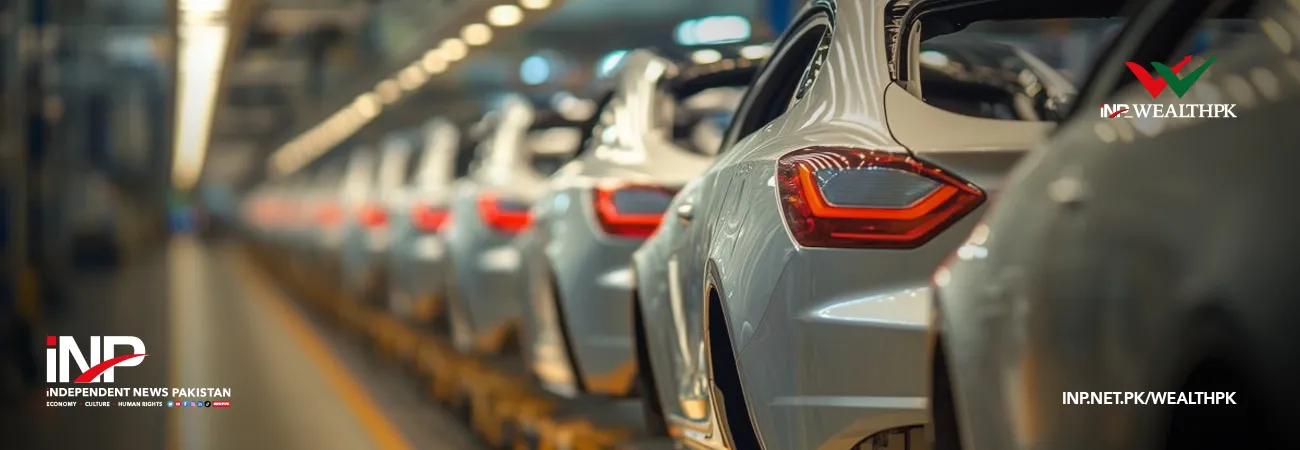
Pakistan’s automobile industry has recorded a strong rebound in production, with overall output rising by about 40% in fiscal year 2024–25 following a sharp contraction in the previous period.
According to a study on Pakistan’s automobile industry prepared by the Centre of Excellence in Competition Law at the Competition Commission of Pakistan, the sector has begun recovering after a slowdown that affected manufacturing activity between 2022 and 2023.
The report notes that the improvement is reflected in industrial performance indicators. The automobile sector registered a 43.94% increase in the Quantum Index of Manufacturing (QIM), which measures activity within Pakistan’s large-scale manufacturing industries.
Production data cited in the study shows significant growth across several vehicle categories during the current fiscal year.
Passenger car production increased by 37.1% between July and March of FY2024–25, rising from 55,678 units to 76,339 units compared with the same period of the previous year.
The light commercial vehicles (LCVs), jeeps, and sport utility vehicles (SUVs) segment also recorded strong expansion. Output in this category grew by 79.8%, increasing from 14,452 units to 26,147 units.
Other segments of the automobile industry also experienced substantial growth during the period. Bus production rose by 83.8%, increasing from 297 units to 546 units, while truck production expanded by 88%, rising from 1,501 units to 2,822 units.
Production of two- and three-wheelers also improved, increasing by 29% from 843,504 units to 1,088,493 units during the same period.
However, the tractor segment moved in the opposite direction. Tractor output declined by 35.3%, falling from 36,425 units to 23,581 units.
The study attributes the broader improvement in vehicle production to stabilizing macroeconomic conditions. Earlier, the industry had faced multiple pressures, including high inflation, elevated energy costs, exchange rate volatility, and restrictions on the import of components used in vehicle assembly.
As these pressures eased, manufacturing activity began to recover. Improvements in inflation trends, a relatively stable exchange rate environment, and lower policy interest rates helped restore confidence among manufacturers while supporting consumer demand through easier access to vehicle financing.
The automobile industry is a key component of Pakistan’s large-scale manufacturing sector, with strong linkages to industries such as steel, plastics, electronics, and rubber.
Because of these extensive supply-chain connections, changes in automobile production often reflect broader trends in industrial activity.
With output rising across most vehicle categories, the sector is showing clear signs of recovery after the earlier downturn, indicating renewed momentum in Pakistan’s manufacturing landscape.
Credit: INP-WealthPk