


INP-WealthPk

KSE-100 posts steepest monthly drop since March 2020 amid geopolitical jitters
April 07, 2026
By Moaaz Manzoor
The Pakistan Stock Exchange (PSX) came under heavy pressure in March 2026, with the benchmark KSE-100 Index plunging 19,319 points month-on-month to close at 148,743, reflecting a negative return of 11.5 percent — its sharpest monthly decline since March 2020 in percentage terms.
According to Arif Habib Limited (AHL), the market remained unsettled throughout the month as investor sentiment was dented by heightened geopolitical tensions, rising global oil prices, persistent domestic selling, and the seasonal slowdown during Ramadan.
The month was marked by pronounced volatility. The KSE-100 opened March at 152,717 points, climbed to an intra-month high of 161,475, and later slipped to a low of 144,119, underscoring the nervous mood that dominated the market.
Market participation also weakened during the month. Average daily traded volume fell 37 percent to 487 million shares, while average traded value declined 30 percent to $99.1 million, indicating cautious investor activity amid an uncertain environment.
Sector-wise, banks emerged as the biggest drag on the benchmark, wiping out 7,078 points. Cement followed with a negative contribution of 2,888 points, while fertilizer and auto assemblers pulled the index down by 2,543 points and 874 points, respectively.
Among individual stocks, United Bank Limited (UBL) was the largest negative contributor, eroding 2,987 points from the index. Fauji Fertilizer Company (FFC) dragged the benchmark lower by 1,697 points, followed by Habib Bank Limited (HBL) with 1,119 points, National Bank of Pakistan (NBP) with 1,011 points, and Lucky Cement (LUCK) with 975 points.
In terms of sectoral returns, Vanaspati and Cable & Electrical were the worst performers, each plunging 31 percent during the month. Textile Composite fell 25 percent, Insurance declined 22 percent, while Leather and Engineering both lost 18 percent.
Foreign investors remained net sellers in March, with outflows amounting to $53 million. AHL said the selling was concentrated mainly in banks, cement, and fertilizer stocks. On the domestic side, buying by banks and DFIs, individuals, and other organizations offered some support, partially offsetting foreign withdrawals.
Speaking on the market’s performance, Ali Najib, Deputy Head of Trading at AHL, said the PSX witnessed a positive session at the close of the month, with the KSE-100 Index gaining 1,900 points, or 1.29 percent, to settle at 148,743, as investor sentiment improved.
He said fresh buying emerged on expectations of a favorable outcome from an upcoming press conference by the United States Department of War.
Najib said March 2026 proved to be a deeply adverse period for equities, with the KSE-100 Index registering a sharp decline of 19,319 points (-11.5% MoM) to close at 148,743.
He further said the State Bank of Pakistan continued its active role in the foreign exchange market, carrying out cumulative net interventions of $12.4 billion between June 2024 and December 2025, including $1.0 billion in December 2025 alone, in an effort to maintain currency stability and strengthen reserve buffers.
He also highlighted a key corporate development, noting that Lucky Motor Corporation had entered into a strategic partnership with Guangzhou Automobile Group to introduce new energy vehicle brands AION and HYPTEC in Pakistan, signalling progress in the country’s electric vehicle landscape.
Looking ahead, AHL expects the market to remain sensitive to geopolitical developments in the near term. It said any improvement in the external environment could support a recovery, while the upcoming corporate results season may shift investor focus back to fundamentals. The brokerage house added that approval of the recently agreed IMF tranche of around $1.2 billion by the Executive Board could further strengthen market sentiment.
Despite the sharp correction, valuations remain attractive from a longer-term perspective. The KSE-100 Index is currently trading at a price-to-earnings ratio of 7.3x and offering a dividend yield of about 6.9 percent, according to AHL.
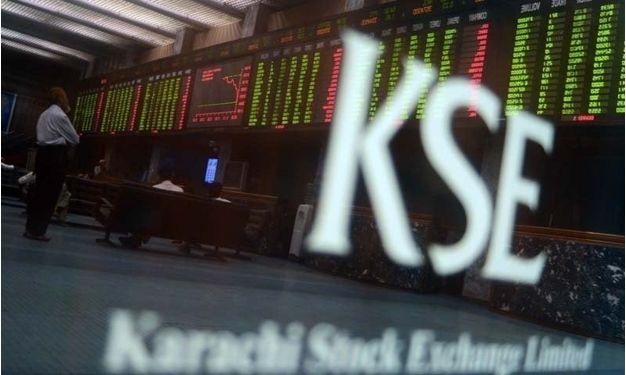
Credit: INP-WealthPk