




INP-WealthPk

Fed tightening raises cost risks for Pakistan’s return to global bond markets
October 15, 2026
By Qudsia Bano
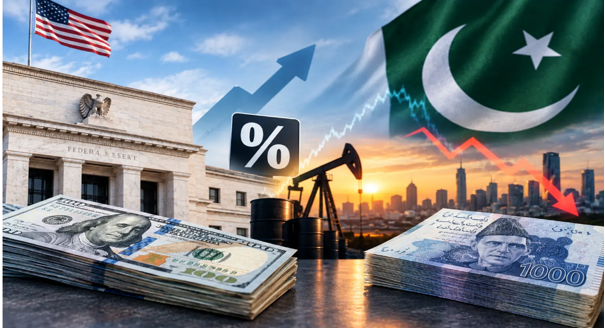
Pakistan’s renewed access to international capital markets could grow increasingly costly if US monetary tightening persists. Higher American interest rates raise the baseline cost of dollar borrowing while simultaneously putting down pressure on emerging-market currencies.
The risk has gained greater relevance following the US Federal Reserve’s latest policy reversal and Pakistan’s own return to international bond markets.
The Federal Reserve increased its federal funds target range by 25 basis points to 3.75-4.00%, citing elevated inflation. The move marked a change from the easing cycle seen in late 2025, when the Fed had cut rates in September, October and December.
For Pakistan, the issue is not simply that US rates have risen. The more important question is what those rates mean when Islamabad next approaches investors for dollar financing.
Pakistan has recently re-established a more regular presence in international capital markets. The Finance Ministry confirmed this month that the country completed a $3 billion dual-tranche Eurobond transaction, while the government has also appointed international banking consortiums to support future Eurobond, Sukuk and rupee-denominated, dollar-settled bond issuances.
That makes the international interest-rate environment increasingly relevant to Pakistan’s financing strategy.
Sovereign dollar bonds are generally priced with reference to US benchmark rates plus a country-specific risk premium. Even if Pakistan succeeds in improving investor confidence and reducing its sovereign spread, a higher underlying US rate can still keep the overall borrowing cost elevated.
Higher US rates can also trigger global capital flight towards dollar-dominated assets, potentially reducing the availability of private international financing for emerging markets and strengthening the US currency. Against this backdrop, tighter US monetary conditions have important consequences for emerging economies because they affected both the availability and price of international capital.
Speaking to Wealth Pakistan, Sakib Sherani, Chief Executive of Macro Economic Insights, said when US interest rates rise, global investors have a greater incentive to move capital towards dollar assets, reducing the pool of private international financing available to emerging markets and pushing up its cost.
For Pakistan, Sherani said the pressure operates through another channel as well: a stronger US dollar raises the local-currency value of dollar-denominated sovereign liabilities.
Pakistan may therefore improve its own macroeconomic fundamentals and reduce its sovereign-risk premium, but it cannot control the global benchmark against which its international borrowing is priced.
The immediate impact, however, should not be confused with a repricing of Pakistan’s entire external debt stock.
Finance Ministry data show external public debt stood at about $92.9 billion at the end of December 2025, with multilateral creditors alone accounting for 46%. Commercial bank financing and Eurobond/Sukuk liabilities each represented around 7% of external public debt.
The government has separately said nearly three-quarters of external public debt is concessional and long-term, with an average cost of approximately 4%.
The greater vulnerability therefore lies in fresh commercial borrowing, floating-rate financing and debt that must eventually be refinanced, rather than the entire external debt portfolio.
Pakistan’s existing international bond calendar makes that distinction significant. A $1.5 billion Eurobond carrying a 6.875% coupon matures in December 2027, followed by a $1 billion international Sukuk in January 2029.
If US benchmark rates remain elevated as these and other external financing needs approach, Pakistan could face a choice between accepting more expensive market funding, relying more heavily on official creditors, or waiting for better market conditions where its liquidity position allows.
The broader economic effects could extend beyond sovereign borrowing.
A stronger dollar can increase the rupee cost of external debt servicing and imported goods, potentially adding to inflationary pressures. At the same time, reduced appetite for emerging-market assets can make foreign capital more expensive for Pakistani companies as well as the government.
Such external pressures could also complicate domestic monetary policy. The State Bank of Pakistan kept its policy rate unchanged at 11.5% on September 14, while its foreign exchange reserves stood at $21.39 billion as of September 11.
The stronger reserve position provides Pakistan with a larger buffer against external shocks, reducing the pressure to enter international markets simply because immediate liquidity is unavailable.
The cost of external borrowing, nevertheless, remains consequential. Finance Ministry figures show public external-debt interest payments increased from $1.99 billion in FY2022 to $3.59 billion in FY2025. The ministry itself noted that elevated international interest rates contributed to higher external interest payments.
Pakistan’s debt-management strategy has consequently emphasised longer-term concessional financing, reduced exposure to floating-rate debt, diversification across currencies and funding sources, and a return to international markets when pricing conditions are favourable.
The latest Fed increase therefore matters less as an immediate shock to Pakistan’s existing debt stock and more as a warning about the future price of market access. Pakistan has rebuilt reserves and reopened international borrowing channels, but the cost of using those channels will increasingly depend on a global interest-rate environment over which Islamabad has little control.
Credit: INP-WealthPk
Related Articles