


INP-WealthPk
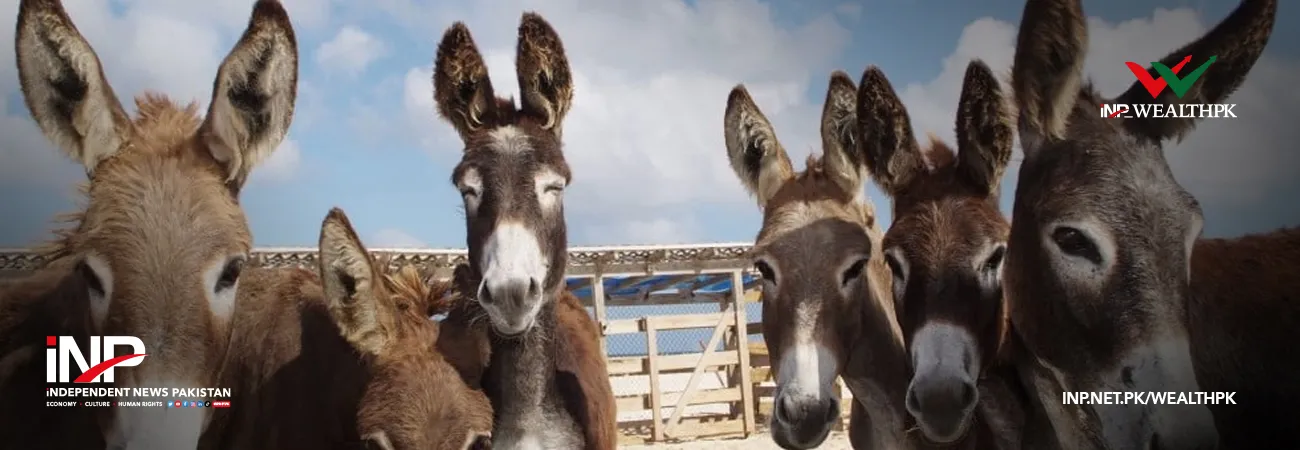
Donkey exports poised to generate $100m annually as commercial farming scales up
February 26, 2026
Azeem Ahmed Khan
Pakistan’s donkey exports could generate millions of dollars annually once commercial farming reaches scale, a livestock expert said, describing the sector as a high-margin opportunity for rural growth and foreign exchange earnings.
“Provincial officials and federal livestock experts have estimated that once commercial farming is fully operational, with a target export of roughly 200,000 to 216,000 donkeys annually, the revenue could easily reach the $100 million mark,” Dr. Muhammad Tariq, Associate Professor at the University of Agriculture Faisalabad and researcher at its Livestock Management Department, told Wealth Pakistan.
He said the projection is no longer theoretical. In late 2024, Pakistan and China signed a formal protocol for the export of donkey meat and hides, paving the way for structured bilateral trade. China’s demand for Ejiao, a donkey-hide gelatin used in pharmaceutical and wellness products, is part of a multi-billion-dollar global industry.
Commercial infrastructure is also taking shape. A specialized donkey slaughterhouse established by Hangeng Trade Company in the Gwadar Free Zone was cleared for operations earlier this year. The facility is designed to process more than 210,000 donkeys annually, closely aligning with official export targets.
Dr. Tariq noted that Pakistan’s donkey population reached 6.05 million in 2025, ranking among the largest globally and underscoring the animal’s enduring economic role in agriculture and informal transport. However, he said, its export and value-added potential remains largely untapped.
“The humble donkey, often overlooked in modern agricultural economies, has immense untapped potential that can drive economic prosperity in Pakistan,” he remarked.
Beyond transport and farm work, donkeys provide meat, hides and derivatives, which are increasingly sought in international markets. Hides are used in gelatin and specialized pharmaceutical products, while donkey milk is gaining traction in the cosmetic industry. These trends, he said, present Pakistan with a “golden opportunity” to diversify livestock exports.
However, he cautioned that expansion must be supported by structural reforms. Local breeds such as Shingari and Sperki are known for their resilience and strength, but the sector faces challenges including over-exploitation, weak health management and outdated husbandry practices. Donkeys working in coal mines often endure harsh conditions, resulting in respiratory illnesses and injuries.
“There is a dire need for strategic action,” Dr. Tariq stressed, calling for genetic improvement programmes, modern breeding management and training in advanced husbandry techniques to enhance productivity while safeguarding animal welfare.
He also underscored the importance of stronger research, reliable data and coordinated collaboration among government bodies, private investors and research institutions. Establishing processing units for hides and milk, along with developing a donkey semen production industry, could help position Pakistan as a competitive global exporter.
“With cohesive planning and modern management,” Dr. Tariq concluded, “the donkey sector can transition from subsistence support to a structured export industry driving rural development and economic growth.”
Credit: INP-WealthPk