



INP-WealthPk
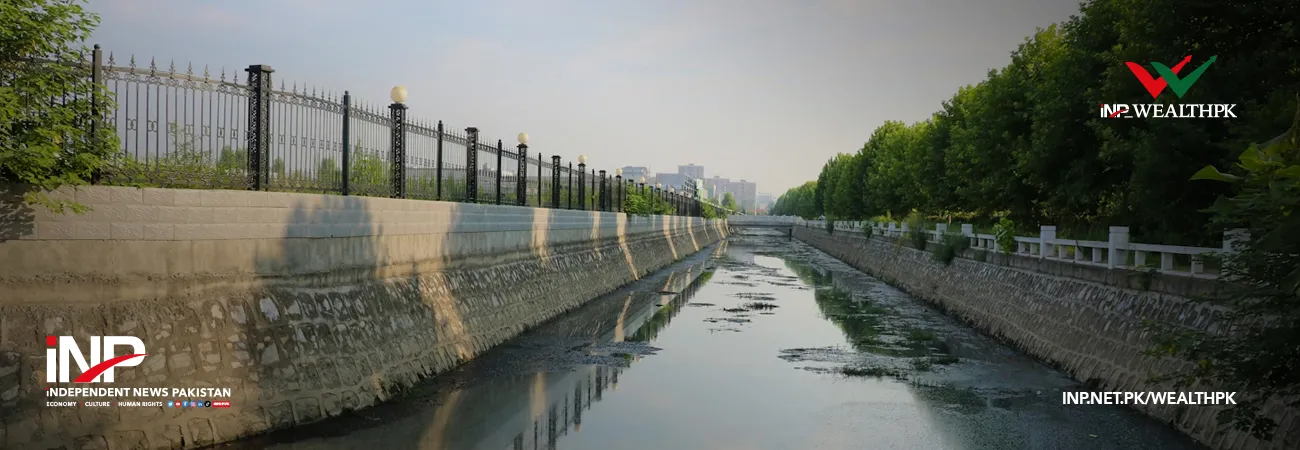
China’s rural water reforms highlight gaps in Pakistan’s service delivery model
April 20, 2026
By Hasan Salahuddin
Pakistan’s deepening rural water crisis calls for a shift toward reliable, professionally managed, and financially sustainable service delivery models — an approach China has recently advanced through integrated rural water reforms.
In March 2026, China’s Ministry of Water Resources, in coordination with five other government departments, issued a circular setting comprehensive standards for rural water systems, with a focus on emergency supply redundancies and diversified financing. The move reflects a shift from infrastructure expansion toward ensuring dependable, professionally managed, and economically viable water services.
China’s rural water reforms have produced measurable results, underscoring the gap Pakistan still needs to bridge. By the end of 2025, China had achieved near-universal rural tap water access, reaching 96% coverage nationwide through integrated utility-based systems.
In contrast, Pakistan’s rural water services remain underdeveloped. World Bank data on safely managed water access shows only 13% coverage in Khyber Pakhtunkhwa, 48% in Punjab, and 29% in Sindh, highlighting significant disparities in access to safe and reliable water.
Pakistan’s 2018 National Water Policy, endorsed by the Council of Common Interests, outlines frameworks for integrated water resource management, conservation, and improved water security. However, implementation gaps persist, pointing to the need to move beyond construction-focused approaches and ensure systems remain operational, financially viable, and resilient over time.
Syed Jawad Muzaffar, Project Director at the United Nations Industrial Development Organization (UNIDO), stressed the importance of transitioning from fragmented, village-level schemes to integrated systems at the tehsil or district level.
“The key lesson is to move from a ‘build more schemes’ approach to a service delivery model centered on reliability, sustainability, and resilience,” he said.
He also highlighted the need to adopt measurable performance benchmarks, including hours of supply, system uptime, and compliance with water quality standards — practices widely used in China’s monitoring framework.
Disaster risk management expert Majid Zaman Khan emphasized the role of professionalization and climate resilience in improving rural water systems. He pointed to China’s use of smart technologies for real-time water quality monitoring and stressed the need for Pakistan to design infrastructure suited to climate risks such as floods and droughts.
He also underscored the importance of sustainable tariff structures to support operation and maintenance through cost-recovery mechanisms, along with stronger coordination between provincial and local institutions.
Ameera Kamal, Senior Consultant at WaterAid Pakistan, highlighted on-ground operational challenges. She noted that while community-managed systems exist, their long-term sustainability depends on the ability to finance ongoing maintenance.
She cited emerging entrepreneur-led models in Okara and Sialkot, where treated water is sold directly to households, improving access through innovative delivery mechanisms. However, she cautioned that such models face constraints related to energy, affordability, and water availability.
Load shedding and voltage fluctuations reduce system capacity, increase energy consumption, and weaken filtration efficiency. At the same time, rising inflation has significantly increased the cost of filters and spare parts, delaying repairs and, in some cases, forcing systems to shut down. She added that not all rural communities can afford solar-powered alternatives.
Kamal stressed that lasting solutions require not only improved financing mechanisms but also a shift in public attitudes toward water use. “Once water comes with a cost, usage becomes responsible,” she said, emphasizing the importance of community awareness around conservation, rainwater harvesting, and the true cost of supply.
Experts broadly agree that Pakistan must move toward professionalized service delivery backed by secure maintenance funding, standardized quality benchmarks, and climate-resilient system design.
China’s integrated, performance-driven approach — built on utility-based management and continuous monitoring — offers a tested framework. However, adapting it to Pakistan’s institutional, financial, and climate realities will be key to achieving meaningful and lasting reform in rural water services.

Credit: INP-WealthPk