




INP-WealthPk

China’s expanding AI ecosystem widens scope for Pakistan tech cooperation
October 15, 2026
By Qudsia Bano
China’s rapidly expanding artificial intelligence computing ecosystem is creating fresh scope for Pakistan to broaden bilateral technology cooperation beyond conventional telecom infrastructure towards advanced computing, research, skills development and locally developed AI applications.
The latest developments in China’s AI hardware and computing infrastructure come as Pakistan seeks to strengthen its own AI capabilities and give CPEC 2.0 a greater focus on innovation, industrial upgrading and technology transfer.
Huawei announced at HUAWEI CONNECT 2026 in Shanghai on September 17 that development of its new Ascend 960 AI processors was progressing ahead of schedule. The Ascend 960DT is expected in the first quarter of 2027, followed by the Ascend 960PR in the third quarter, while the company plans to introduce the Ascend 970 and 980 in 2028 and 2029.
The company has simultaneously expanded the computing systems surrounding its processors. Its new Atlas 960E SuperPoD can connect as many as 4,096 neural processing units and provide eight EFLOPS of FP8 computing performance. Huawei says multiple SuperPoDs can also be combined into much larger AI computing clusters.
For Pakistan, such advances are relevant as access to high-performance computing increasingly becomes an important requirement for advanced AI research and development.
The country’s policy framework is already moving in that direction. Pakistan’s National Artificial Intelligence Policy calls for a national AI compute grid comprising high-performance computing centres and industry-driven data centres, with computing and dataset access planned for at least 100 academic institutions for AI research and development.
The government has also announced plans for seven AI hubs and 20,000 training opportunities under the National AI Advancement Initiative, while setting a target of developing one million AI-skilled non-IT professionals by 2030.
Against this backdrop, Pakistani experts see growing potential to link the country’s emerging AI infrastructure and skills requirements with China’s expanding technology ecosystem.
Talking to Wealth Pakistan, Dr Hassan Daud Butt, Senior Advisor to Energy China and former Project Director of the China-Pakistan Economic Corridor (CPEC), said the latest advances in Chinese AI technologies could become particularly relevant as Pakistan seeks to give CPEC 2.0 a stronger focus on innovation, industrial upgrading and technology transfer.
“Pakistan should not look at these developments merely from the perspective of importing advanced hardware. The bigger opportunity is to build partnerships that give Pakistani researchers, companies and young professionals access to computing capacity, technical expertise and platforms on which locally relevant AI solutions can be developed,” he said.
Butt said Pakistan-China technology cooperation could increasingly connect Chinese technology companies with Pakistani universities, startups and industries.
“If cooperation is designed around capacity building and joint development, AI can become another area where the relationship moves from infrastructure creation towards knowledge and technology-based economic activity,” he said.
Khalid Hussain, Associate Professor in the Computer Science Department at COMSATS University Islamabad, Wah Campus, said the development was important for countries such as Pakistan because the next stage of AI growth would depend increasingly on access to computing resources rather than software knowledge alone.
“Pakistan has a large pool of students and software developers, but advanced AI research requires access to high-performance computing, specialised processors and practical development environments. Cooperation with companies working at this level could help our universities narrow that infrastructure gap,” he told Wealth Pakistan.
Hussain said collaboration should ideally provide universities with access to AI computing facilities and development tools while also supporting faculty training, student research and industry-linked projects.
“The real value would come when Pakistani researchers are able to train and test models on advanced computing platforms and then use that capability for local applications. Agriculture, healthcare, manufacturing, logistics, cybersecurity and language technologies are areas where locally trained AI systems can have direct economic and social value,” he said.
He added that access to hardware alone would not produce a sustainable AI ecosystem. Pakistan would also need stronger expertise in parallel computing, data engineering, model optimisation and efficient use of computing resources.
Butt said linking Pakistan’s domestic initiatives with China’s expanding technology ecosystem could turn AI into a practical new pillar of bilateral cooperation.
“Pakistan should seek partnerships that leave capability behind — trained people, stronger research institutions, local applications and commercially viable products. That is how cooperation in advanced technologies can generate lasting economic value,” he said.
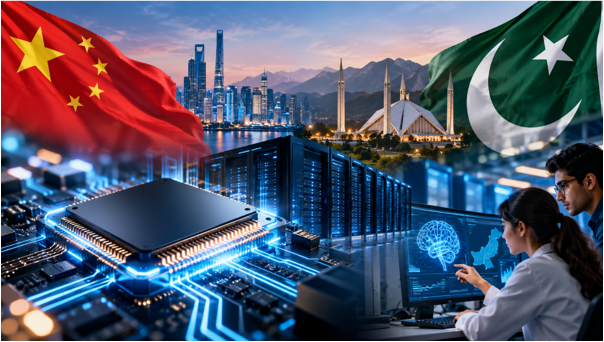
Credit: INP-WealthPk
Related Articles