



INP-WealthPk
Afghan corridor closure costs Pakistan $850m in trade earnings
June 16, 2026
By Moaaz Manzoor
Pakistan has suffered an estimated $850 million loss in exports and transit earnings in seven months as the closure of the Afghan trade corridor disrupted shipments to Afghanistan and Central Asian markets, according to a Ministry of Commerce document available with Wealth Pakistan.
The document shows that the Afghanistan conflict has blocked a key regional trade route at a time when Pakistan is already facing pressure on exports, freight movement and access to landlocked Central Asian countries. It said the border trade situation with neighbouring countries had remained strained, largely due to the ongoing conflict with Afghanistan.
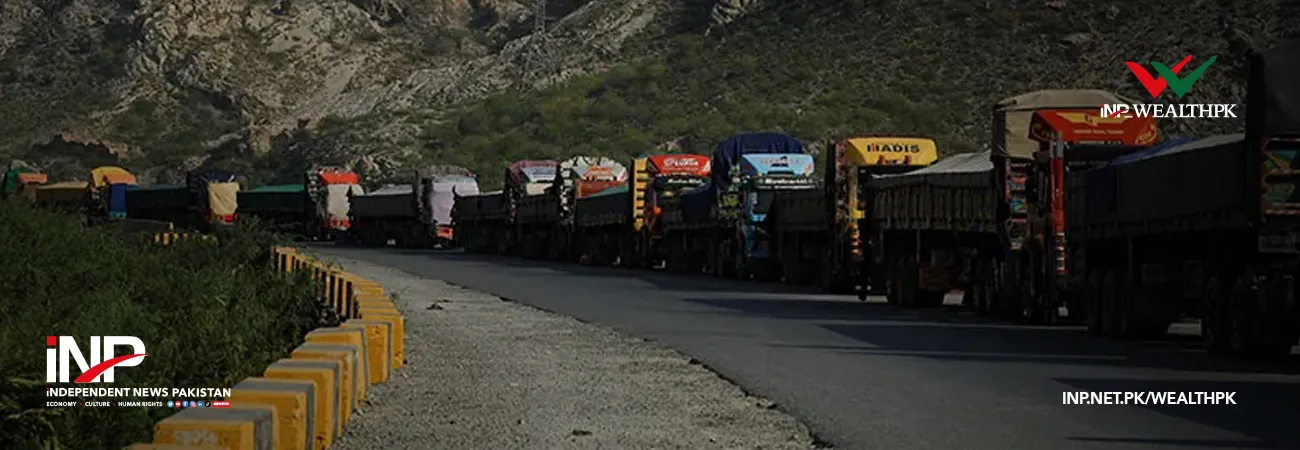
According to the document, the Afghan border has remained closed since October 11, 2025, stopping all trade with Afghanistan and countries in the region through the Afghan corridor. More than 7,500 transit containers were stranded at seaports and border crossing points, while trucks carrying bilateral and transit cargo remained stuck on both sides of the border.
A detailed table in the document showed Pakistan’s exports to Afghanistan, Russia and Central Asian countries fell 68 per cent to $335.62 million during the October-April FY2025-26 period from $1.040 billion in the same period last year. It separately put the loss in exports at $705 million and the loss in transit earnings at $100 million.
The sharpest decline was recorded in exports to Afghanistan, which fell 88.3 per cent to $85.64 million in the Oct-April period of FY26 from $818.13 million over the same period last year. Exports to Russia dropped 20.7 per cent to $28.18 million, while shipments to Kyrgyzstan declined 15.4 per cent, Tajikistan 27 per cent and Turkmenistan 52.1 per cent.
Some Central Asian markets, however, recorded gains despite the disruption. Exports to Kazakhstan rose 17 per cent to $153.43 million from $136.49 million last year, while exports to Uzbekistan jumped 62.7 per cent to $59.28 million from $38.51 million last year. These gains were not enough to offset the steep fall in Afghanistan-bound trade.
The disruption has directly affected exporters, transporters and traders of perishable goods. The Ministry of Commerce document said traders of fruits and vegetables on both sides suffered losses, while Pakistan lost export opportunities in pharmaceuticals, cement, processed food, tractors and motorcycles.
Transporters have also been hit. According to the document, Pakistan’s transporters earn an average of $200 million per year from Afghanistan and Central Asian transit trade, which has stopped after the closure of the corridor.
Imports from Afghanistan, Russia and Central Asian states also declined sharply during October-March FY2025-26. Imports from Afghanistan fell 88.3 per cent to $55.60 million from $475.28 million previously. Imports from Russia dropped 53.3 per cent, while imports from Tajikistan, Turkmenistan and Uzbekistan fell 97.3 per cent, 85.8 per cent and 92.7 per cent, respectively.
The document said that efforts were underway to activate alternative trade through Iran and China corridors. It said options for re-routing via Iran and China, airlift and re-export had been offered for forward transit cargo of Central Asian states.
The document further said Afghanistan Transit Trade cargo was allowed re-export to the country of origin or any other seaport. Humanitarian cargo of UN agencies was allowed to cross over to Afghanistan.
To keep some regional exports moving, the government granted a waiver from the condition of a financial instrument for the export of kinnow and potato to the Commonwealth of Independent States through the Iran corridor for the current season. Since December 2025, more than 7,000 trucks carrying 200,000 metric tonnes of kinnow and potato worth $40.2 million have been exported to Central Asian states through the Iran corridor.
The document also said that meetings were held with China on March 19 at the Ministry of Foreign Affairs and again on April 7 under the Quadrilateral Traffic in Transit Agreement framework with China, Kazakhstan and Kyrgyzstan to discuss new routes and inclusion of Uzbekistan and Tajikistan in the agreement.
The figures show that the Afghan corridor closure has become more than a bilateral border issue. It has disrupted Pakistan’s access to regional markets, reduced transit income and forced exporters to rely on alternative routes. The immediate test will be whether the Iran and China corridors can restore trade flows before exporters lose further ground in Afghanistan and Central Asia.
Credit: INP-WealthPk