


i NEWS PAK-CHINA
Sino-Pak researchers map drought links along CPEC from Xinjiang to GwadarBreaking
January 06, 2026
A new climate study covering the China–Pakistan Economic Corridor (CPEC) and areas along its route, including southwest Pakistan, says that understanding how dry weather develops into agricultural drought could help authorities improve drought management in arid regions.
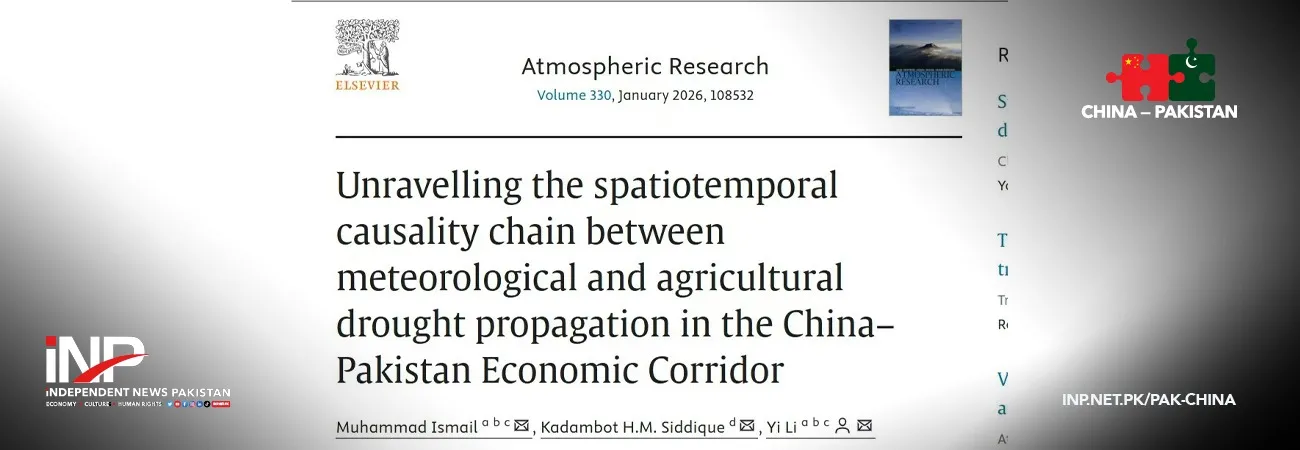
The study, published in January 2026 in the journal Atmospheric Research, is titled “Unravelling the spatiotemporal causality chain between meteorological and agricultural drought propagation in the China–Pakistan Economic Corridor.”
According to a Gwadar Pro's report on Tuesday, itexamines how meteorological drought propagates into soil-moisture deficits and agricultural drought along the CPEC corridor, which the authors describe as stretching from Kashgar in Xinjiang to the port of Gwadar in southwestern Pakistan.
The authors say drought poses major risks to ecosystems and society, and that understanding how meteorological drought evolves into agricultural drought is important for developing mitigation strategies.
The study used data covering 1981 to 2022 and applied Enhanced Convergent Cross Mapping (ECCM) alongside neural-network models—ANN, DNN and FFNN—supported by explainable AI (XAI) to analyse drought propagation dynamics.
The paper reports a strong causal relationship between meteorological and agricultural drought and notes that propagation timing varies by region. Based on ECCM, it finds that propagation times ranged from 3–4 months in northern/southern Xinjiang and eastern Pakistan to 1–2 months in eastern Xinjiang and western Pakistan. It also identifies maximum temperature and soil moisture as key drivers of drought transitions.
The research was supported by the National Natural Science Foundation of China, the Natural Science Foundation of Shenzhen, and High-end Foreign Experts Introduction Projects.
Credit: Independent News Pakistan (INP) — Pak-China
Related News