


i NEWS PAK-CHINA
Pakistani researcher sees microbial technologies boosting Pakistan's agricultureBreaking
August 07, 2026
A Pakistani agricultural researcher working in China believes deeper scientific collaboration can help Pakistan adopt advanced Chinese agricultural technologies to improve crop productivity, strengthen soil health and promote sustainable farming.
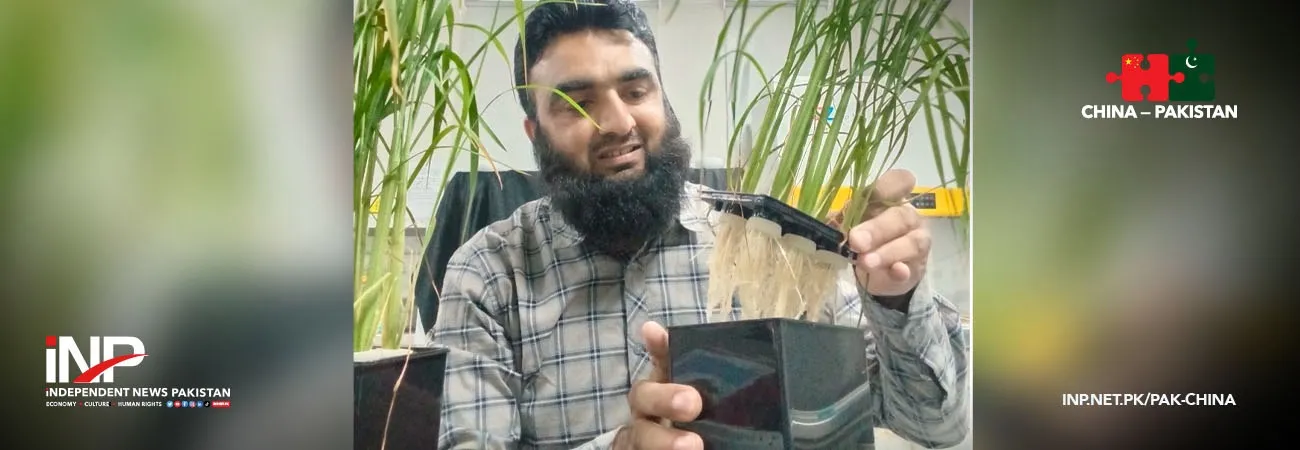
In an interview with Gwadar Pro, Dr. Hafiz Muhammad Rizwan, a Pakistani postdoctoral researcher at the Sanya Research Institute of the Chinese Academy of Tropical Agricultural Sciences (CATAS), shared his views following the inauguration of the Yazhou Tropical Agricultural Science International Talent Station in Sanya, Hainan Province, where he represented international researchers
"As a Pakistani scientist, I see myself as a bridge between the two countries. My aim is to connect Chinese agricultural expertise with Pakistan's research priorities and farming challenges, particularly in beneficial microorganisms, fruit-crop improvement, plant stress resistance and sustainable agriculture," he said.
Having conducted research in China since 2015, Rizwan specializes in beneficial microorganisms and plant-microbe interactions for developing climate-resilient and sustainable agricultural systems.
He noted that agricultural cooperation between Pakistan and China has expanded under the Belt and Road Initiative (BRI) and the South-South Cooperation (SSC) framework. Recent MoUs between Pakistani and Chinese universities on plant tissue culture technology, online training for Pakistani students on technology transfer, and Chinese experts' participation in mushroom cultivation programs in Pakistan reflect the growing scope of bilateral collaboration.
Rizwan said Pakistan should prioritize China's biological control and agricultural microbial technologies, particularly microbial biofertilizers, biopesticides and advanced microbial fermentation systems, to reduce dependence on chemical fertilizers and pesticides while improving soil fertility and crop resilience.
However, he stressed that these technologies should not be imported directly. "The objective is not to copy Chinese technologies directly, but to evaluate, adapt and validate them under Pakistan's crops, soils, climate, farming systems and economic conditions," he said.
According to Gwadar Pro, he suggested that Chinese and Pakistani researchers jointly identify suitable microbial strains, conduct biosafety assessments and multi-location field trials, transfer fermentation and formulation technologies, and eventually establish local production of biological agricultural inputs in Pakistan.
According to Rizwan, after completing his postdoctoral research, he hopes to help establish joint China-Pakistan research platforms, validate microbial biofertilizers and biological crop-protection technologies under Pakistani conditions, and expand researcher exchanges and technical training programs.
He believes such cooperation could enable Pakistan to develop locally adapted biological solutions for major crops while reducing reliance on imported agricultural inputs and strengthening national scientific capacity.
Rizwan said effective China-Pakistan collaboration over the next three to five years could help farmers improve crop productivity, adopt sustainable agricultural inputs, reduce postharvest losses, modernize farming practices and improve market access through technology transfer and stronger extension services.
Credit: Independent News Pakistan (INP) — Pak-China
Related News