


i NEWS PAK-CHINA
China’s digital energy advances as Pakistan seeks battery storage solutionsBreaking
September 19, 2026
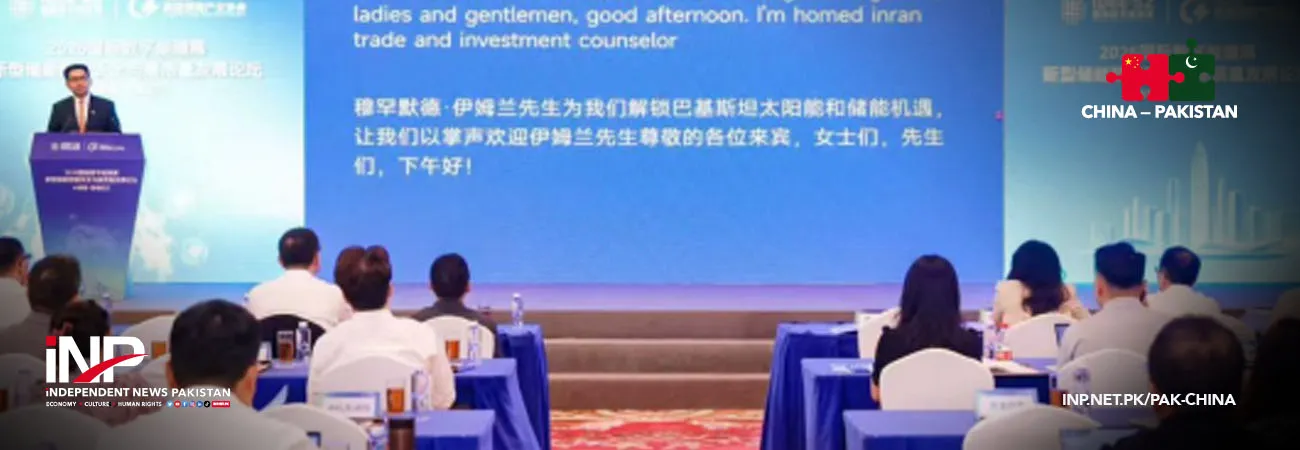
“Battery storage is not an option for Pakistan. It is a core component of our energy security,” Muhammad Imran, Pakistan’s Trade and Investment Counsellor in Guangzhou, told an audience in Shenzhen.
He was delivering a keynote speech titled “Unlocking Opportunities in Pakistan’s Energy Storage Market” at the 2026 New Energy Storage Digital Intelligence, Safety & High-Quality Development Forum, Gwadar Pro reported.
He noted that Pakistan has set a national target to raise the share of clean energy in its electricity mix to 90 percent by 2035.
The forum was a sideline of the 2026 International Digital Energy Exhibition, held at the Shenzhen Convention and Exhibition Center from Sept 15 to 17 and co-launched with the 2026 Energy Green Development Conference.
Spanning more than 50,000 square meters, the event brought together participants from over 50 countries and regions and nearly 400 overseas enterprises, showcasing nearly 100 digital energy innovations.
The counsellor’s message reflects Pakistan’s energy reality. According to Pakistan’s Ministry of Energy, clean energy sources including hydropower, nuclear, wind and solar account for approximately 55 percent of the country’s electricity generation, while nearly 38 gigawatts of distributed solar have been installed through consumer-led investment.
Federal Minister for Energy Sardar Awais Ahmad Khan Leghari has said battery storage is essential to shift surplus daytime solar power to peak hours and reduce reliance on imported fuels.
To support this, Pakistan has proposed the National Lithium-Ion Battery Manufacturing Policy 2026–2031, which sets out phased localization targets, tariff reforms and performance-based incentives to encourage manufacturing and private sector investment.
Pakistan’s cooperation with China is already moving forward, with partnerships taking shape between the two countries.
One example is a memorandum of understanding signed in June between Pakistan’s Saigol Group and China’s Hebei Juhang Energy Technology Group on advanced lithium-ion batteries, energy storage systems and electric vehicle charging infrastructure.
Haroon Akhtar Khan, Special Assistant to the Prime Minister on Industries and Production, described it “a declaration of confidence in Pakistan’s industrial future and in the enduring strength of Pakistan-China cooperation.”
He added that China’s remarkable transformation into a global leader in innovation, electric vehicles, battery technologies, renewable energy, artificial intelligence and advanced manufacturing provides valuable lessons for developing economies.
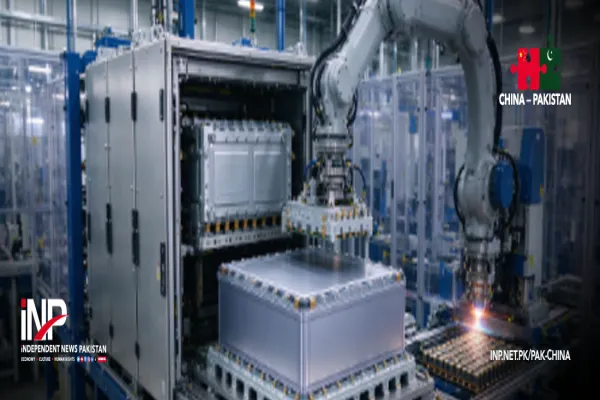
China’s new-type energy storage capacity has grown rapidly in recent years, with lithium-ion battery technology, liquid-cooled ultra-fast charging and photovoltaic inverters among the innovations on display at the Shenzhen exhibition.
Companies including Huawei, BYD and BTR are among the global leaders in the sector.
Muhammad Imran said he looked forward to strengthened industrial coordination between China and Pakistan in energy storage, advancing technological innovation and global deployment amid the AI-driven energy transition.
Credit: Independent News Pakistan (INP) — Pak-China
Related News