


i BLOGS

Was Mir Ahmed Bangulzai Missing by Choice?Breaking
January 15, 2026
Balochistan is Pakistan’s largest province, yet it stands as its most neglected and broken. Decades of tribal conflict, political manipulation, and state violence have turned this vast and resource-rich land into a place of fear, grief, and unanswered questions.
The blood spilled in Balochistan does not belong to politicians or generals. It belongs to rickshaw drivers trying to earn a living, van drivers taking passengers home, motorcyclists on their way to work, and pedestrians simply walking down familiar streets. Suicide bombings do not choose targets; they consume whoever happens to be nearby. Behind every explosion are families left shattered, still asking the same haunting question years later: Why our loved one? What was their crime?
Instead of schools, hospitals, and jobs, the people of Balochistan have inherited an endless war. A war so confusing and chaotic that even those living through it can no longer tell who is fighting whom, or for what cause.
Activists claim that over the past two decades, thousands of ethnic Baloch men have been forcibly disappeared by Pakistan’s security forces. They speak of illegal detentions, torture, and extrajudicial killings carried out under the shadow of a decades-long separatist insurgency. The state, however, rejects these accusations outright. Officials insist that those who are “missing” left voluntarily—either to join militant groups or to flee the country.
Some of the disappeared do return. When they do, they are no longer the same people who left. They come back broken, traumatized, and silent—carrying stories they are too afraid to tell. Many others never return at all. Their remains are later found in unmarked graves scattered across the province, bodies so brutally disfigured that even their families cannot recognize them and then there are the women across generations whose lives are being defined by waiting.
Yet the government continues to deny everything. Every accusation is dismissed as propaganda. According to official narratives, the crisis in Balochistan is nothing more than a foreign conspiracy—an Indian plot to weaken Pakistan from within. Security agencies claim that the Baloch Liberation Army (BLA) is funded by India and argue that young men are not abducted but willingly abandon their families to join militant groups.
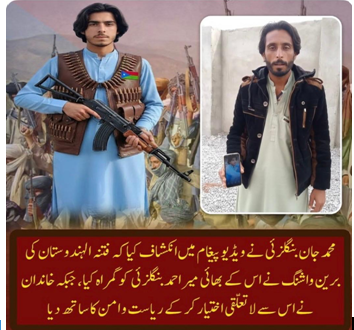
Recently, a video emerged showing Mir Ahmed Bangulzai armed with a gun and ammunition. His brother, Muhammad Jan Bangulzai, later stated that Mir Ahmed had been missing for some time and was misled and recruited by Fitna-e-Hindustan into his organization and that neither he nor the family had any connection to his actions. His pictures are now being circulated widely on social media, presented as “proof” once again that the issue of missing persons is nothing more than Indian propaganda, and that those who leave their homes do so entirely of their own free will.
The state insists that young Baloch men are being brainwashed by India and pushed toward terrorism and suicide bombings. But this raises an uncomfortable and unavoidable question: Can propaganda alone really convince thousands—perhaps generations—of young men to abandon their homes, families, and futures? Is this really a conspiracy of India? Or is this anger being born from decades of humiliation, neglect, and unaddressed injustice?
Credit: Independent News Pakistan (INP)
Related News