


i BLOGS
CDF Global Peace Maker Asim Munir Sets the Stage for Next Round of TalksBreaking
April 17, 2026
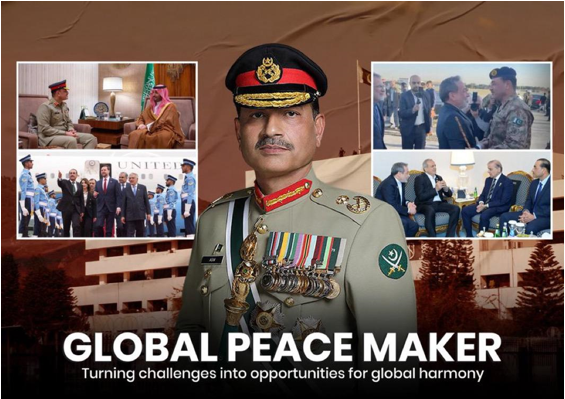
Pakistan has been working harder on its diplomacy in the Middle East. Chief of Army Staff and Chief of Defence Forces Field Marshal Syed Asim Munir met with Iran's top political and military leaders in Tehran for a few important meetings. He met with Iranian President Masoud Pezeshkian, Parliament Speaker Mohammad Baqer Ghalibaf, and high-ranking officers from the Islamic Revolutionary Guard Corps (IRGC), such as those from the Khatam al-Anbiya Central Headquarters. The talks were mostly about how the security situation in the region is changing, how de-escalation efforts are still going on, and how important it is to keep the diplomatic momentum going to lower tensions in the region.
Field Marshal Munir and President Pezeshkian talked about the chances of peace and stability in the Middle East during their meeting. Both sides stressed the importance of continuing to talk and work together more closely to stop things from getting worse. Talks with Iranian military leaders also looked at real steps that could be taken within a new framework to end hostilities and help make the region more stable. Munir said that any attempt to ease tensions must be taken seriously and followed with determination.
People think that the visit is part of Pakistan's larger plan to help Tehran and Washington talk to each other again. As tensions rise in the region, Islamabad has increasingly tried to be a neutral middleman. The United States also publicly supported Pakistan's role as a mediator when the White House said that President Donald Trump saw Pakistan as the main way to talk to Iran. The White House said that several countries had offered to help, but Washington wanted to keep working through Islamabad because Pakistan was trusted by both sides.
At the same time, Prime Minister Shehbaz Sharif continued Pakistan's parallel diplomatic outreach by going to Doha and having detailed talks with Qatar's Emir Sheikh Tamim bin Hamad Al Thani. The two leaders talked about how things were getting worse in the Middle East and agreed that more needed to be done to help calm things down and keep the region stable. The leaders of Qatar thanked Pakistan for its helpful diplomatic role. Shehbaz also said that Pakistan stands with Qatar and condemned recent attacks on Gulf states. The two countries also talked about their relationship with each other and agreed to work together more on security, defence, and energy. They also stressed the need to make sure that global energy supplies are not disrupted in times of regional uncertainty.
After going to Qatar, Prime Minister Shehbaz went to Türkiye for the 5th Antalya Diplomacy Forum, where he is expected to talk about Pakistan's views on important regional and international issues. A big diplomatic event is also expected to happen in Turkey, where the foreign ministers of Pakistan, Turkey, Egypt, and Saudi Arabia will meet. The talks will be about the security situation in the Middle East, tensions between Iran and the US, working together to fight terrorism, working together on energy issues, and connecting the region. Officials think that these coordinated diplomatic efforts in Tehran, Doha, and Türkiye show that Pakistan is playing a bigger role in trying to get people talking and set the stage for real negotiations in the region.
The people of Pakistan are expressing pride in the leadership of Chief of Defence Forces Field Marshal Syed Asim Munir, whose emphasis on dialogue over conflict has been widely seen as a reflection of responsible and visionary statesmanship. At a time of rising regional tensions, his approach highlights the importance of diplomacy, restraint, and constructive engagement in addressing complex challenges.
Credit: Independent News Pakistan (INP)
Related News