


INP-WealthPk
Pakistan outlines $350m gemstone export potential by 2030
January 19, 2026
Farooq Awan
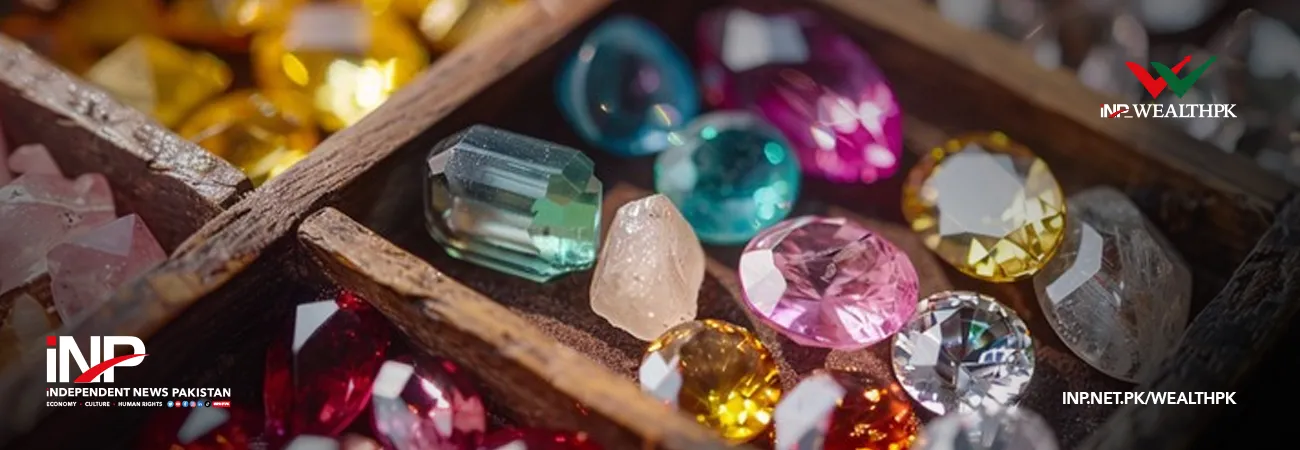
The federal government has outlined the potential to raise Pakistan’s gemstone exports to around $350 million by 2030 under the newly drafted National Policy to Realize Pakistan’s Gemstone Potential, which aims to transform the sector into a structured, competitive and export-oriented industry. According to the policy document prepared by the Ministry of Industries and Production, Pakistan possesses one of the world’s most resource-rich endowments of precious and semi-precious gemstones.
These include rubies, emeralds, peridots, pink topaz, aquamarine, tourmaline, garnet and several other varieties, mined primarily from Khyber Pakhtunkhwa, Gilgit-Baltistan, Azad Jammu and Kashmir, and parts of Balochistan. Despite this significant resource base, the country’s documented gemstone exports have remained below $10 million annually, accounting for a negligible share of the global gemstone trade.
The policy notes that Pakistan’s gemstone exports peaked around 2015 and declined over the subsequent decade, although a gradual recovery trend has been observed since 2017, with exports registering a compound annual growth rate of 11.79%. The document highlights that the subdued export performance is not due to resource scarcity but is largely the result of structural weaknesses, including informality, high wastage, limited value addition, weak governance frameworks, and restricted access to finance and international markets.
At the global level, the gemstone trade is valued at approximately $12 billion, having grown at an average rate of around 2.41% over the past several years. Major players such as India, Thailand, Sri Lanka, and Myanmar dominate international trade flows, while Pakistan’s presence remains marginal despite possessing internationally recognised gemstones such as Kashmir rubies, Swat emeralds, Kohistan peridots and Katlang pink topaz, which are regarded among the finest globally.
The policy outlines a five-year roadmap to address these gaps and significantly expand export earnings. Export growth is identified as a central objective, with the document noting that domestic consumption of gemstones in Pakistan is negligible, making exports the primary driver of sectoral expansion. To realise the projected export potential by 2030, the policy proposes comprehensive reforms across the gemstone value chain, including mining practices, processing infrastructure, certification systems, trade facilitation and market access mechanisms.
In addition to boosting export revenues, the policy seeks to curb illicit trade and value leakage, which continue to result in substantial foreign exchange losses. The document highlights that only a very small fraction of Pakistan’s gemstone trade is routed through formal channels, while a significant share of production is exported in the form of rough stones, limiting export realisation. By improving traceability, certification, and formal export mechanisms, the government aims to enhance unit values and capture a larger share of global demand.
The export-oriented strategy is also aligned with broader economic objectives, including job creation, skills development, and responsible investment. Over the policy period, the government plans to support exporters through participation in international exhibitions and structured buyer-seller engagement initiatives to improve market access and enhance the visibility of Pakistani gemstones.
The document states that effective implementation of the policy will require coordinated action across federal and provincial governments, regulatory bodies, financial institutions, and industry stakeholders. A steering committee under the Ministry of Industries and Production will oversee implementation, with periodic reviews to ensure progress remains aligned with sectoral reforms and export growth objectives.
Credit: INP-WealthPk